
Port Katakolon, Greece
Today we stopped at Katakolon in Greece.
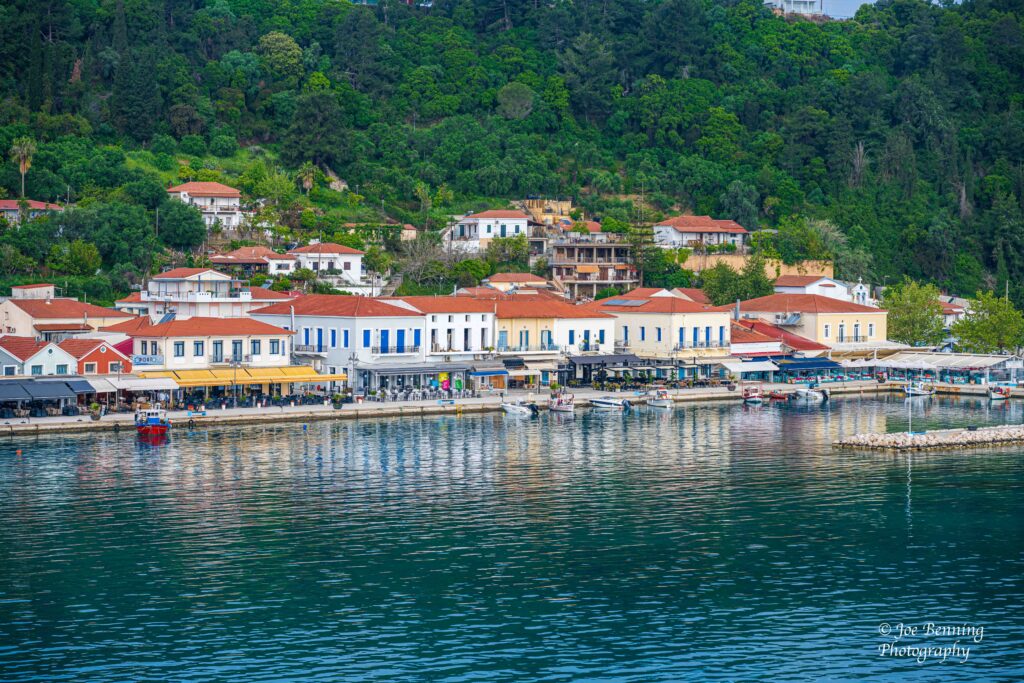
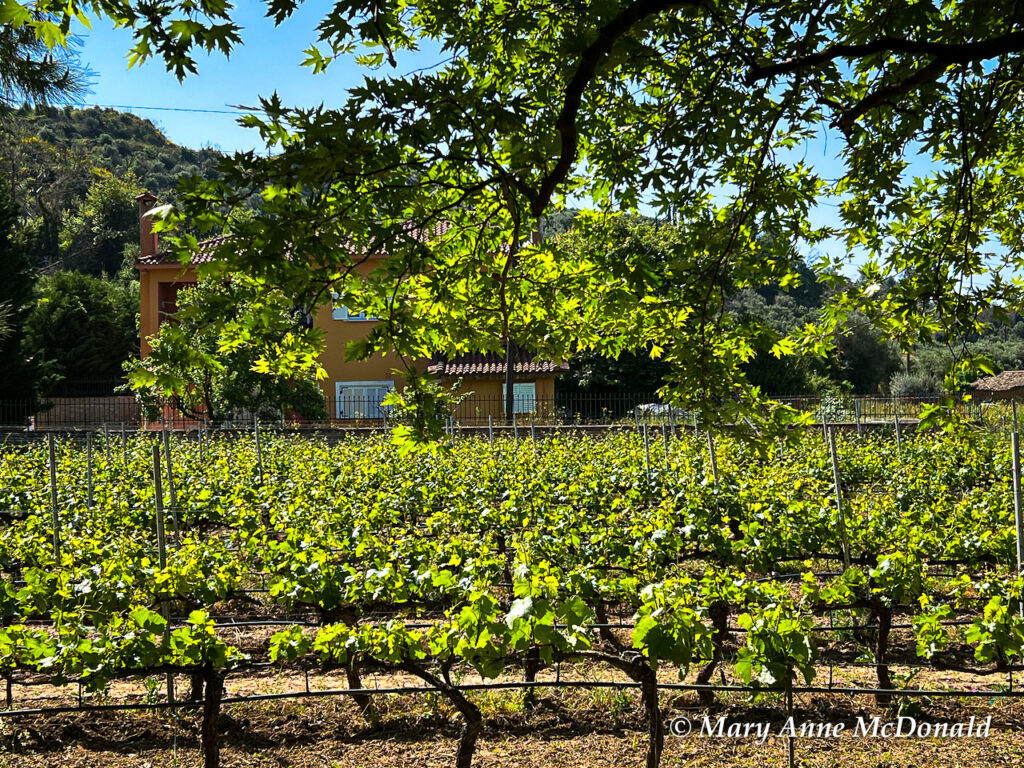
We had the opportunity to visit a vineyard and an olive grove (and the processing plants for their products) near Olympia, Greece. It was a beautiful day to be outdoors and meet the owners of these family businesses – and to taste some very good olive oils and wines.
And then there is the history. Of course, history is involved when you visit Olympia, where the first Olympiad was held in 776 BC. Only ruins remain at the site, but you can imagine the massive Temple of Zeus and the stadium that could hold 45,000 spectators.
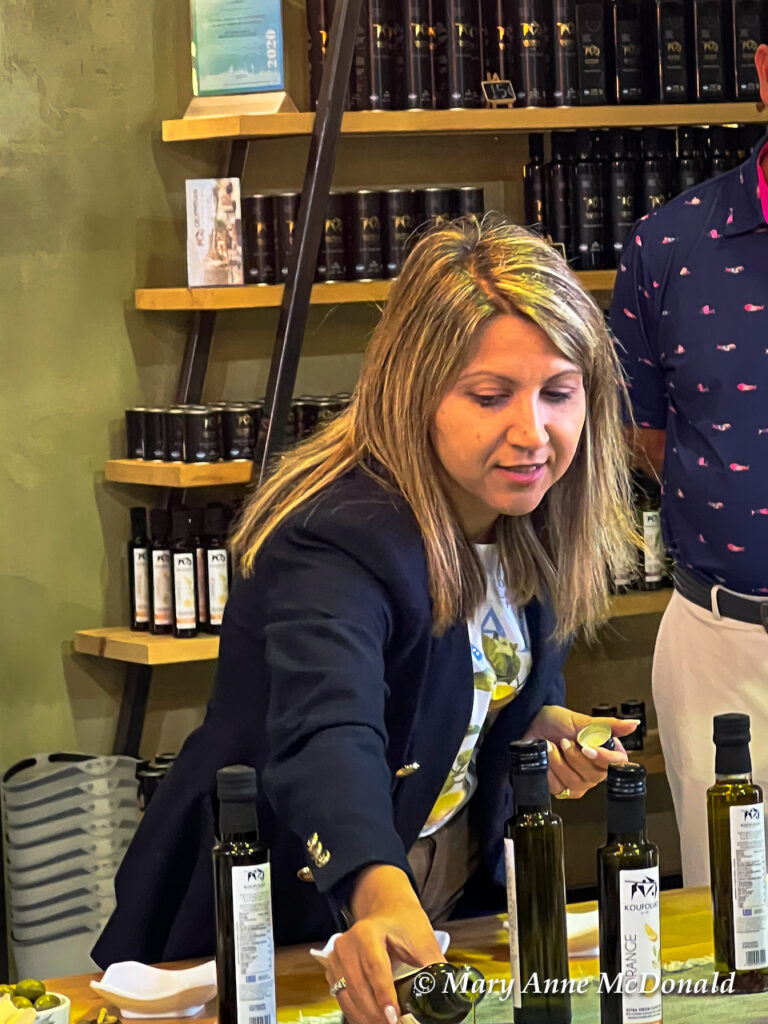
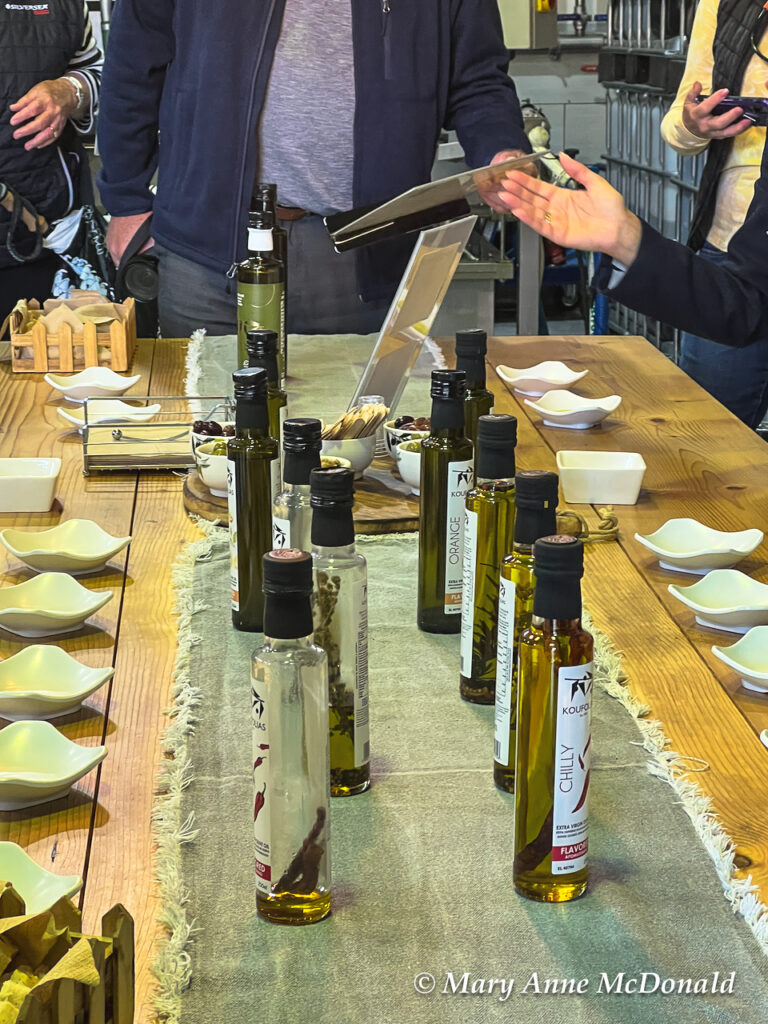
The olive oil grove we visited (Oilympian Olive Oil Mill) is one of many small ones in the area, but it holds the machinery used by many of the local producers to press the olives and bottle the oil. The grapes are pressed on the day they are harvested in order to keep their acidity level low— a requirement to qualify as extra virgin olive oil. The tasting involved various flavored oils (herbs, cheese and citrus flavors) – delicious!
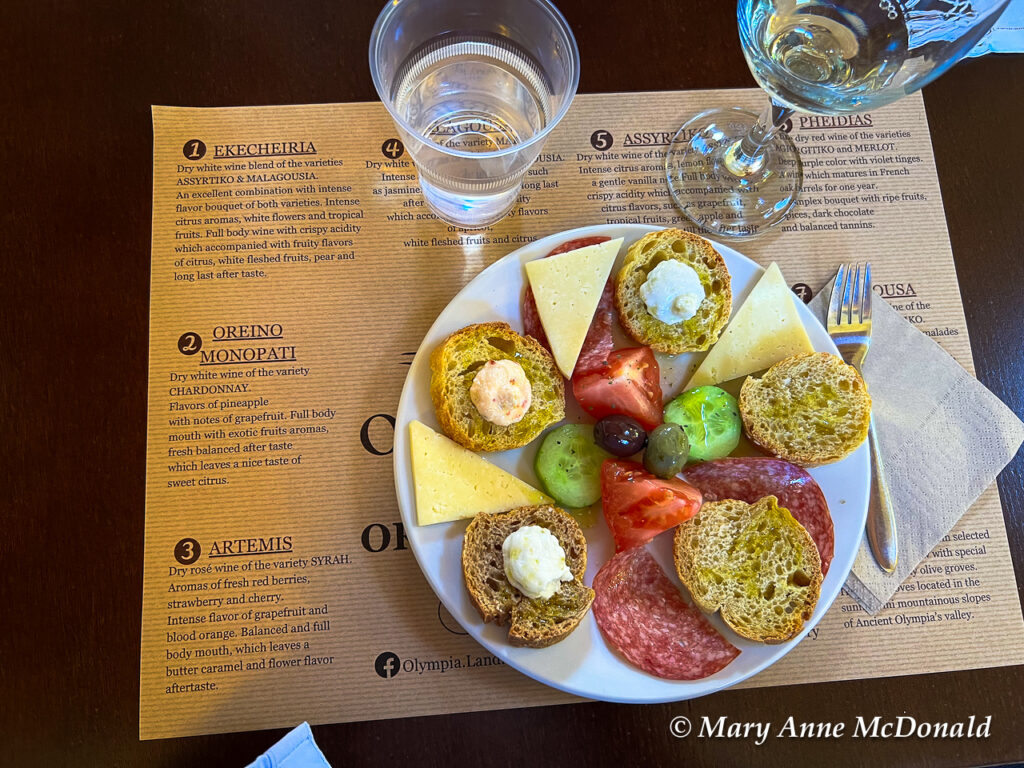
Then on to a lovely vineyard (Olympia Land Estate) to taste some crisp white wines and a dry red, while enjoying local cheese and snacks.
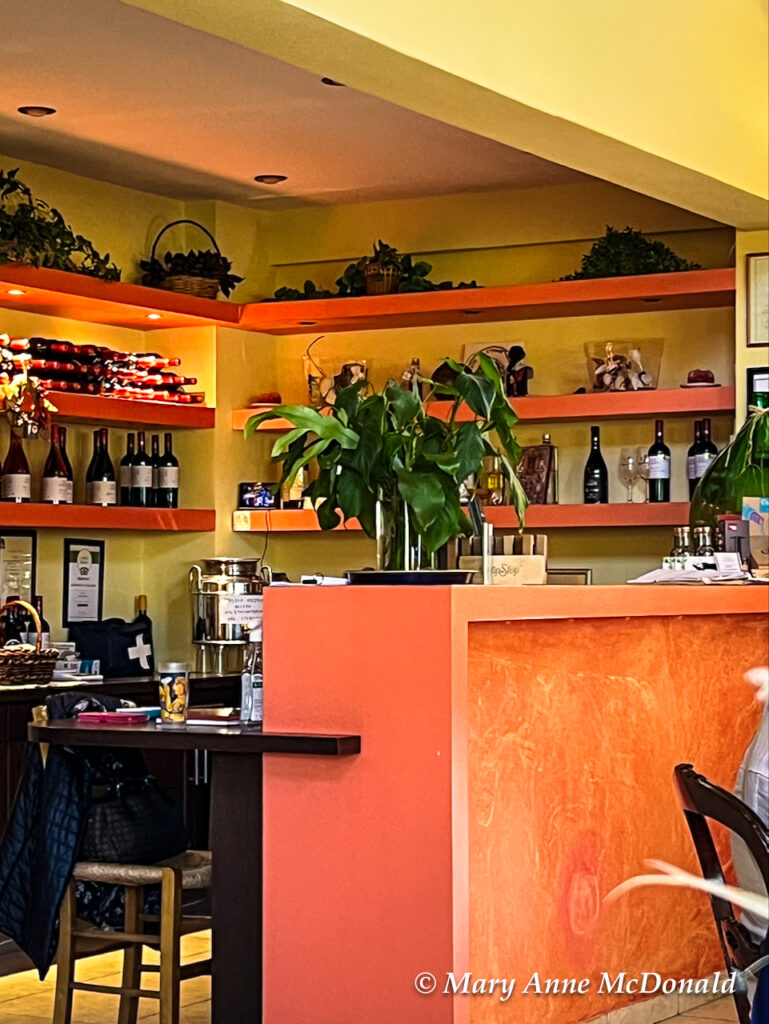
One of the white wines was Assyrtiko, which is getting a lot of buzz in the US these days. It was originally grown by the ancient Greeks on the island of Santorini. Now the vines are grown in Australia, South Africa and the USA, and it is becoming increasingly popular throughout the world.
As it turns out, we were supposed to visit Santorini but due to increased volcanic activity on the island that trip was canceled.
Next stop, Corfu!
MAM and & JFB
Visiting Nafplion, Greece
We did a short (2 ½ hour) walking tour in the small but relentlessly cute town of Nafplion. Greece. It is a coastal city located in the Peloponnese in Greece. Additionally, it is the capital of the regional unit of Argolis and an important tourist destination.
First stop: we visited Kapodistrias Square.
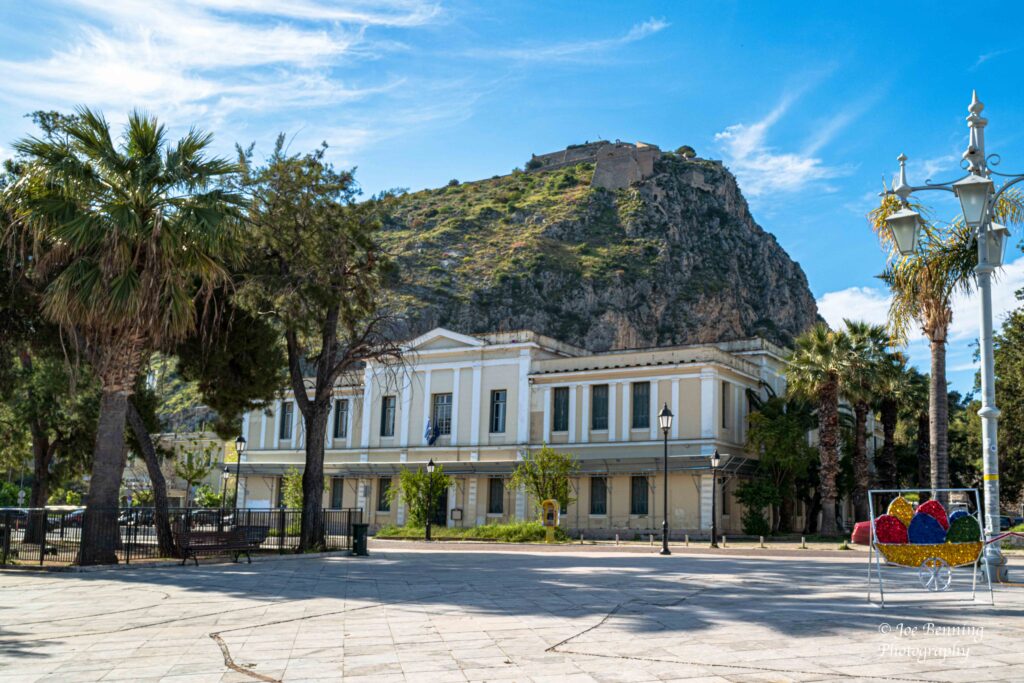
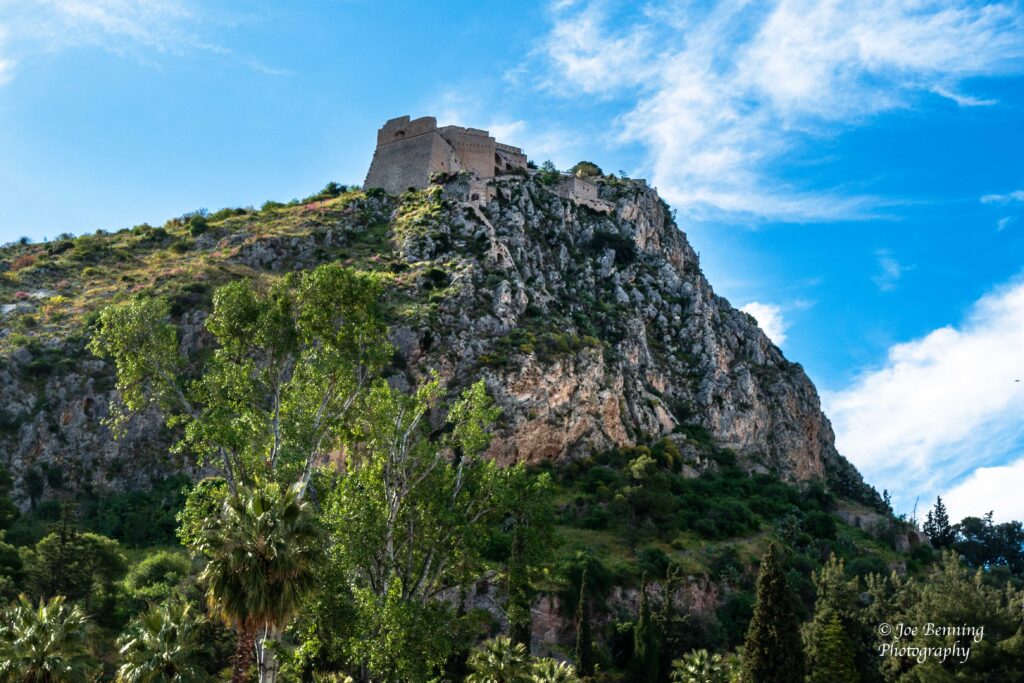
On the top of the mountain there is a fort that dates from medieval times that served to overlook and guard the town from raiders and pirates etc. From our vantage point we could clearly see the fort. One thing to keep in mind though is that the water used to cover where we stood. Only relatively recently (in 1974) did the town modernize the seaport, and largely for the tourist trade.
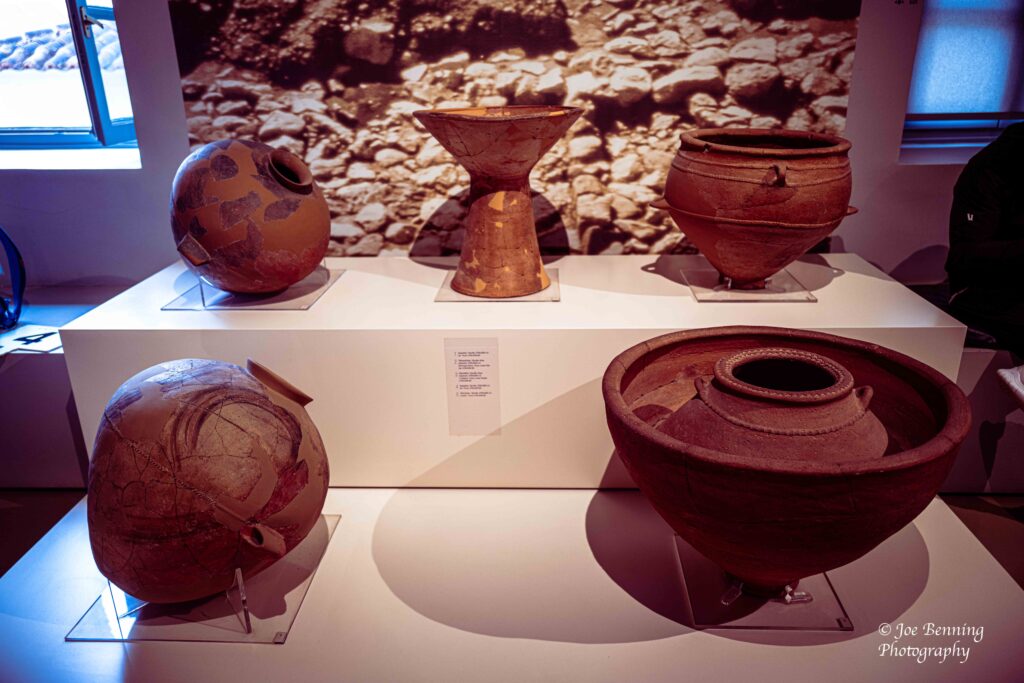
Next we visited an archeological museum, loaded with artifacts. Using symbols, they tell much of the story of how the town progressed through the ages. Because it was a busy seaport, it had many different rulers.
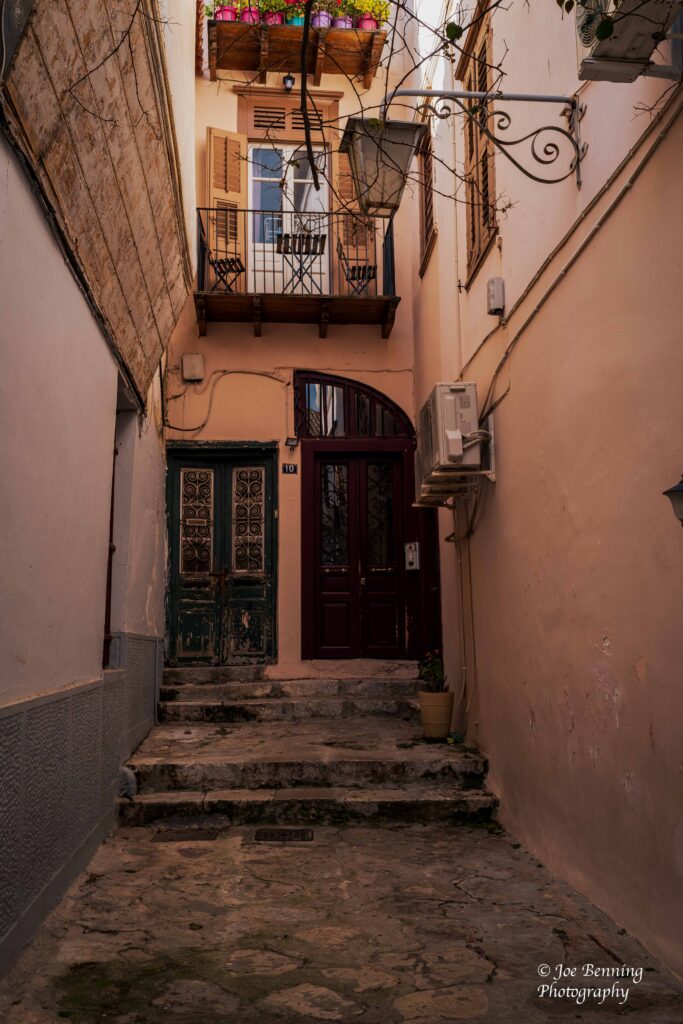
As we walked along on the tour we observed the very narrow side streets that led out to the wide spaces that make up the various town squares.
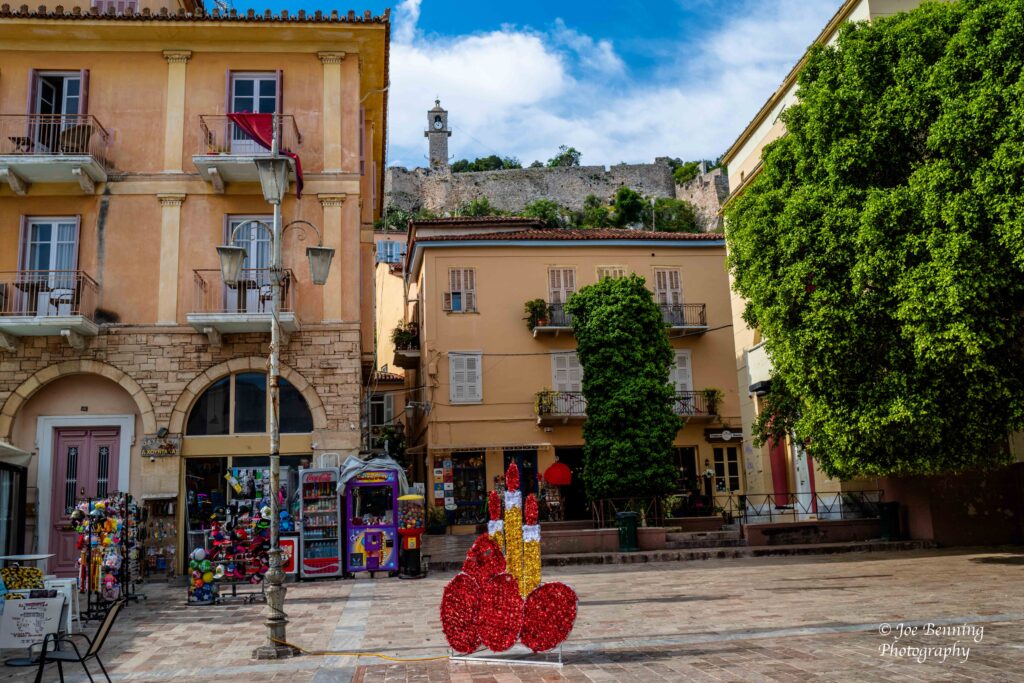
The walls of the city that made up the fortifications are clearly visible from the main town square.
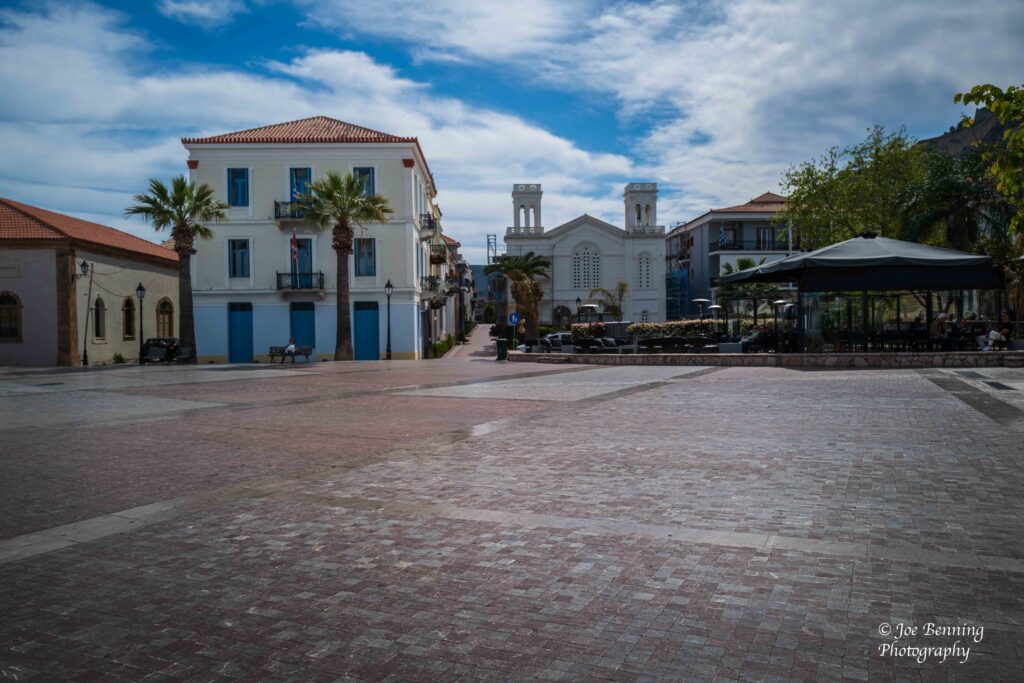
Another thing—back towards the port, there is a large town square where Harvard University has its only presence in Europe! In the photo below it’s the building with the blue shutters.
Finally, we got a good look at the fort on a small island in the harbor that was used to protect the city.
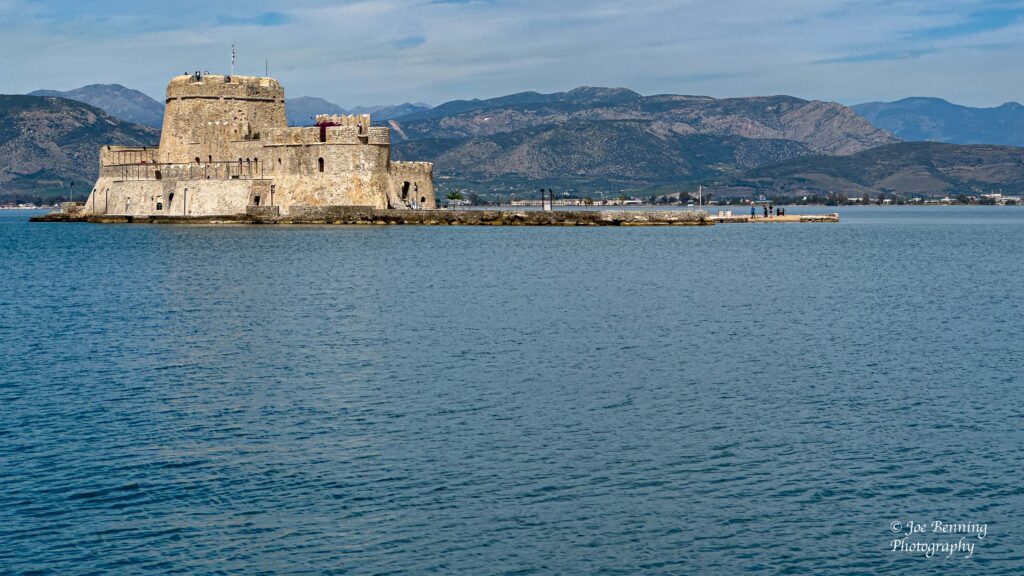
And now it’s back to the ship for dinner and to get ready for the next day’s tour.
JFB
Mykonos, Greece
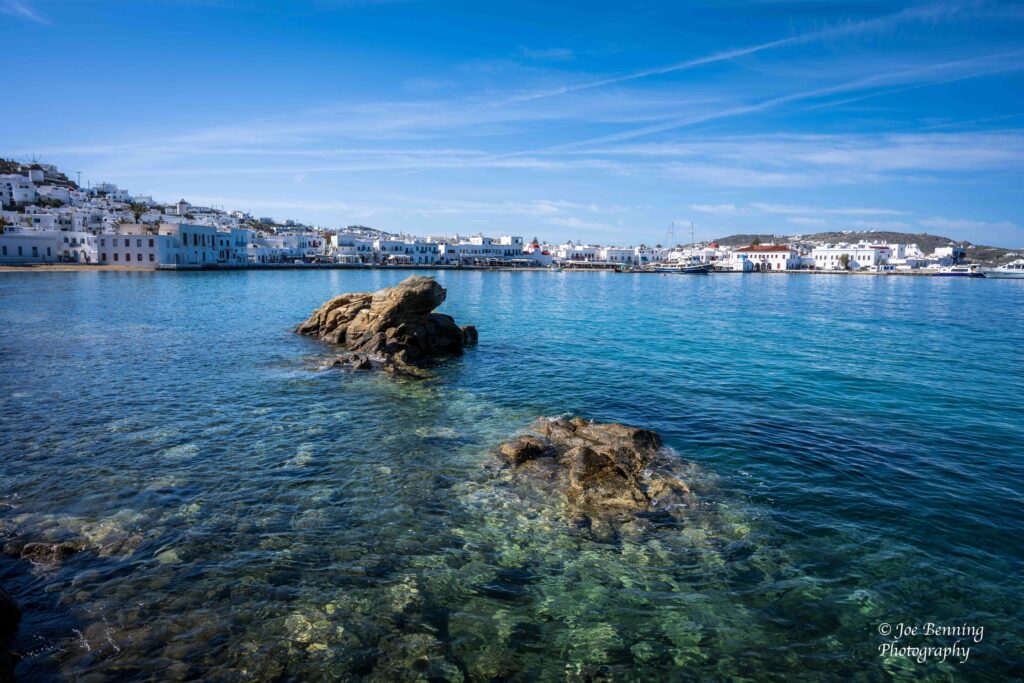
Mykonos is a small windy island that is part of the Cyclades Islands, in the Aegean Sea. It is difficult to grow things on the rocky, steep hills of Mykonos. However, in the past the wind made it a great place for farmers from other islands to come and use the Mykonos windmills (for grinding grain, for example). Now the windmills serve mostly as posh micro-hotels.
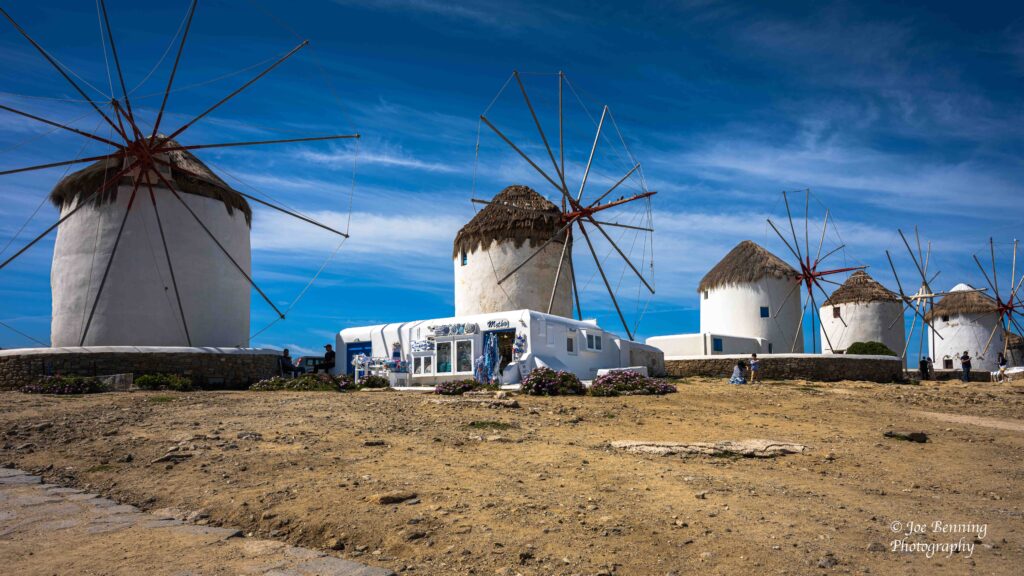
The sandy beaches and great weather make Mykonos a haven for tourists.
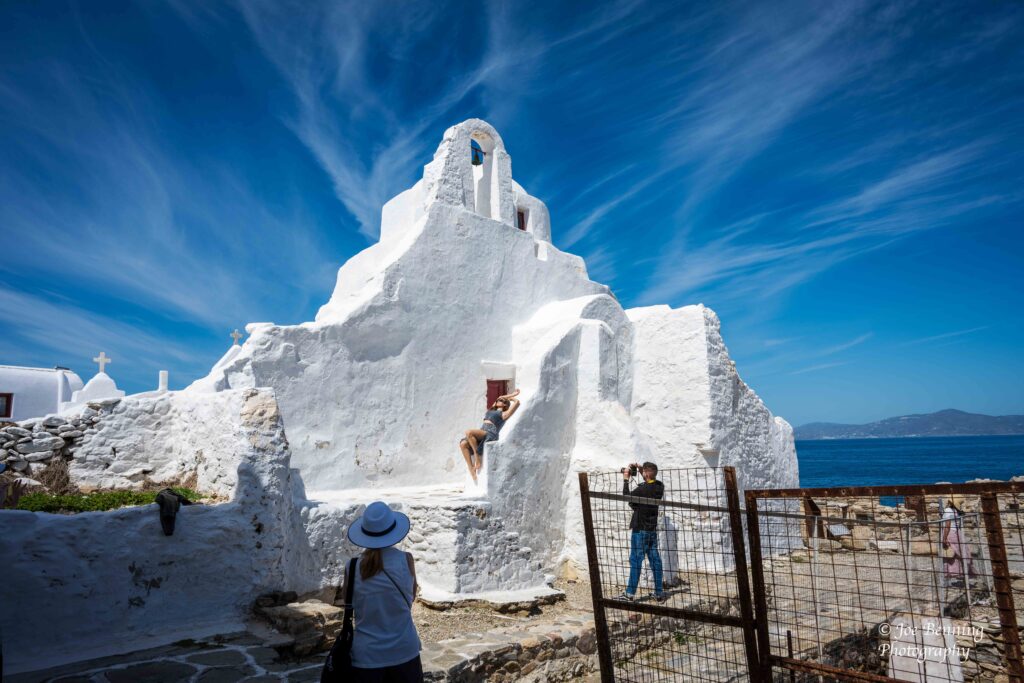
The capital city (named Mykonos) has hotels, restaurants, churches and lots of high-end shops. Many of the streets are narrow and made from cobblestone, with low white-washed buildings on both sides, and are decorated with colorful doors and shutters. The whitewashing that results in the iconic look of the island is required by zoning regs.
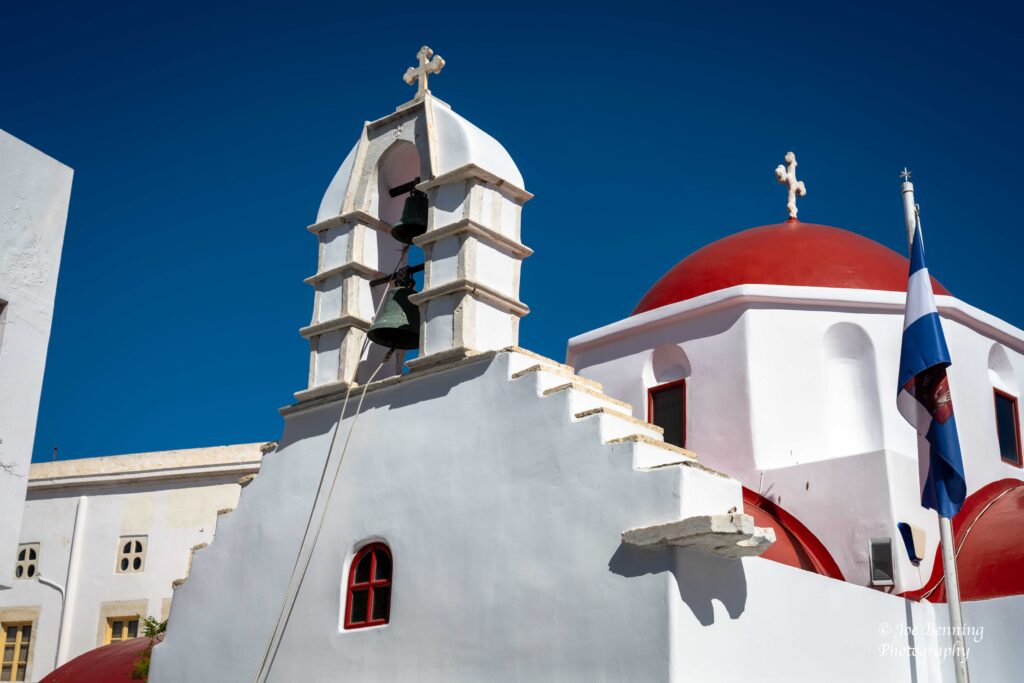
We visited Mykonos on the Saturday before Easter, and the weather was ideal. The streets and restaurants were crowded with visitors, including many Greeks who come from the cities to the islands for the holiday.
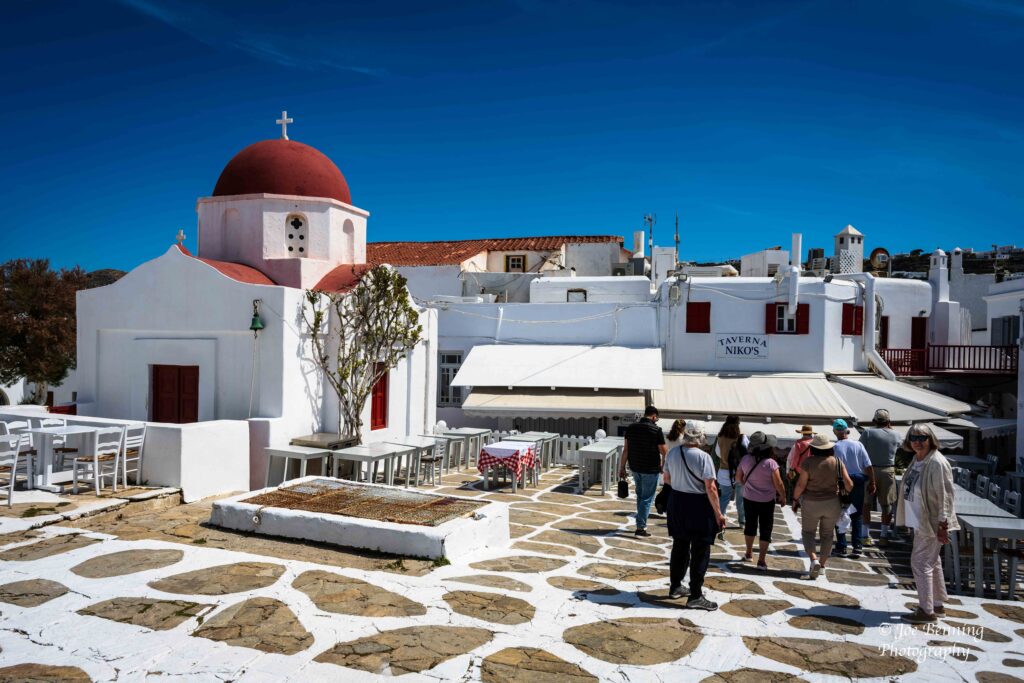
We saw more ornate church interiors, as both the Roman Catholics and the Greek Orthodox/Eastern Catholics prepared for Easter, which occurs on the same day this year. Most of the churches in Mykonos are small, and locals call them chapels.
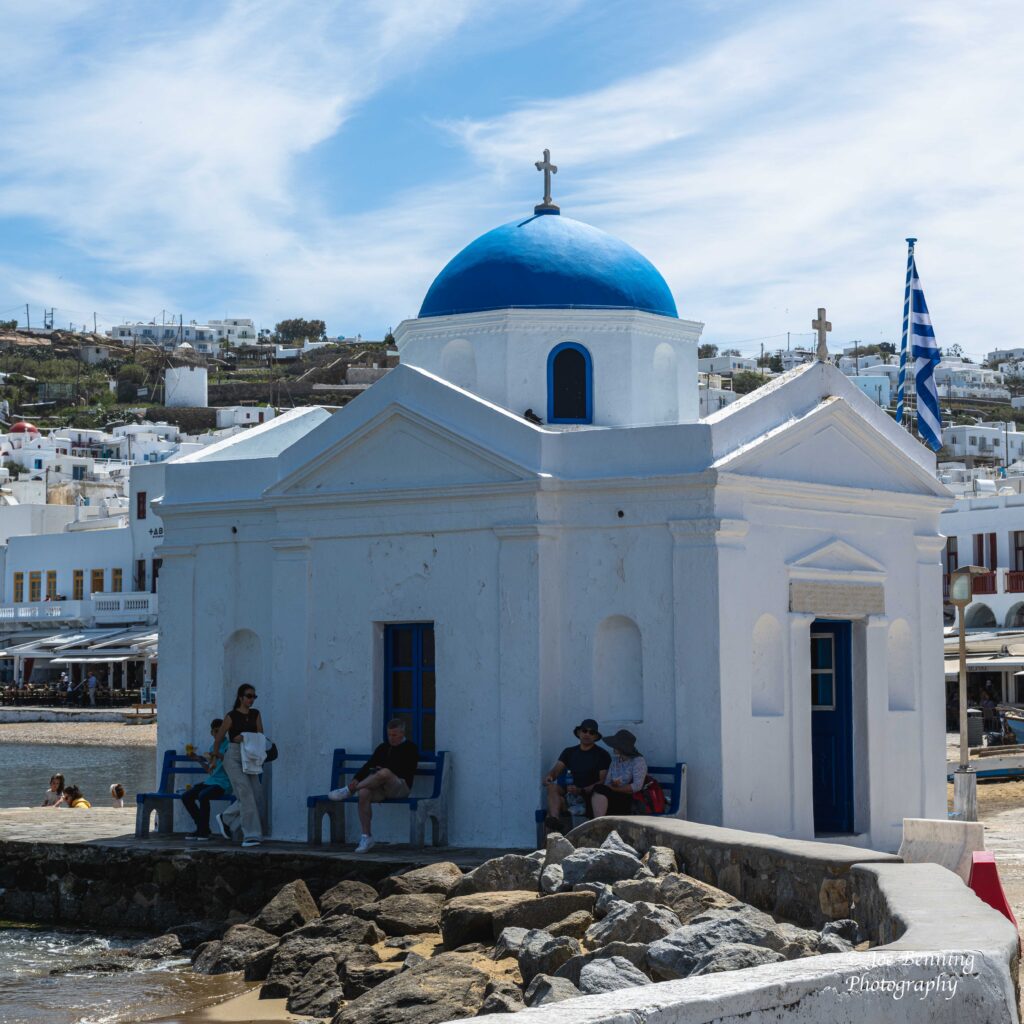
There is, of course, a lot of history and mythology related to Mykonos but we didn’t have time to visit the archeology museum and learn more. So now we have a reason to return!
Mykonos is a must see place that holds (or should hold) a prime spot on everyone’s bucket list.
MAM & JFB
Thessaloniki and Volos, Greece
We are back in Greece now, where we had a nice walking tour of Thessaloniki, Greece’s second largest city (after Athens).
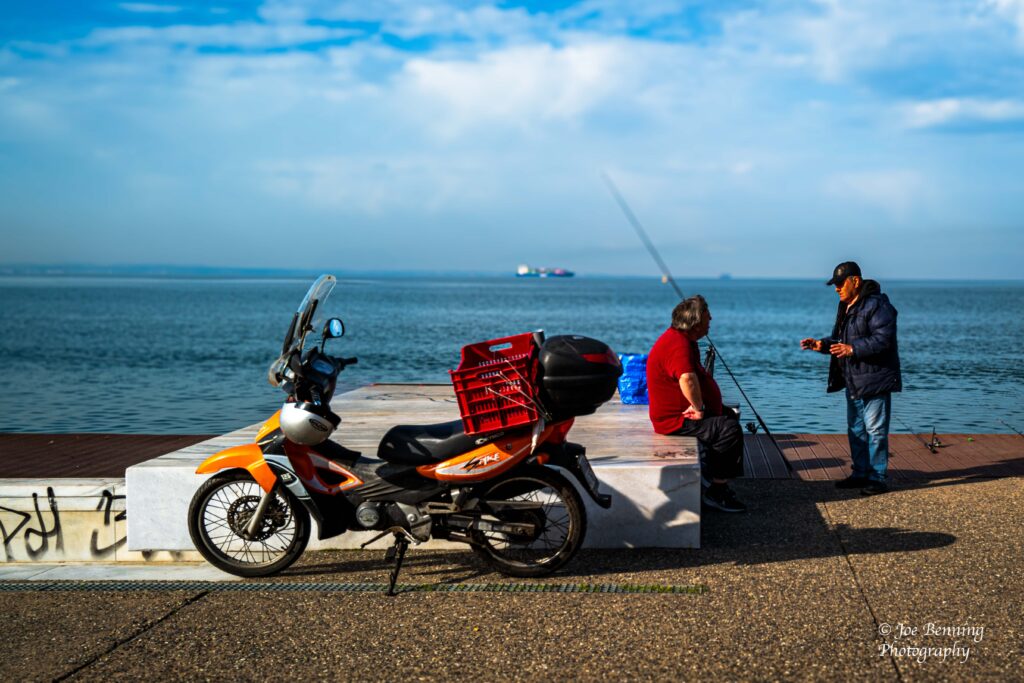
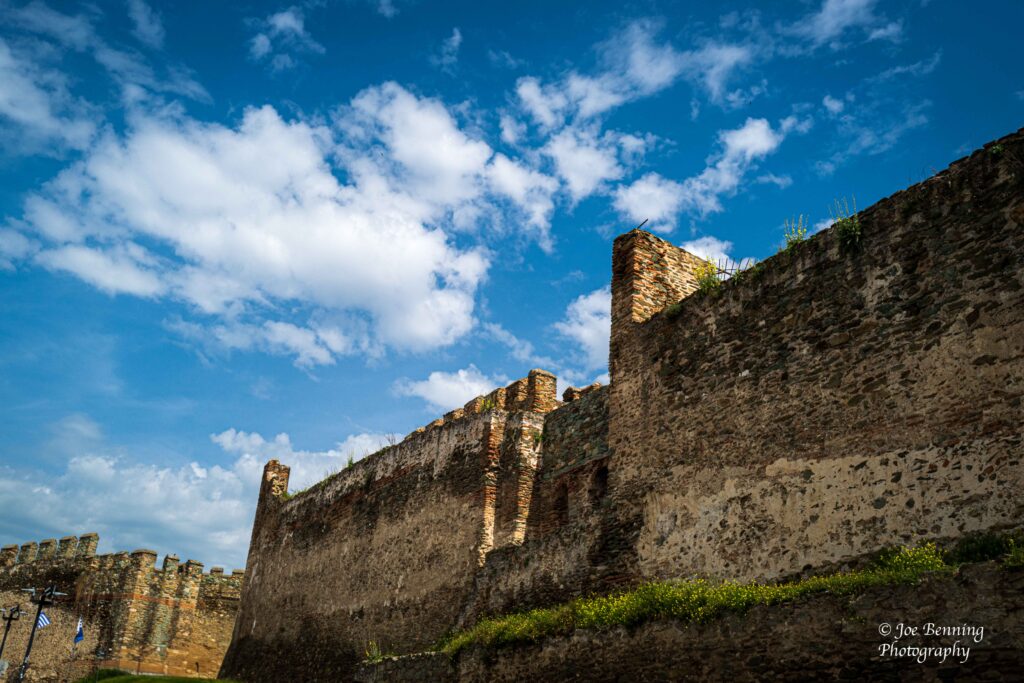
Again, tons of history in this city, some reflected in its archeology museum, and much in the monuments all over the city (including Alexander the Great ).
We spent a good deal of time in the Church of St. Dimitrios, learning about the Greek Orthodox church, and some of the ways it differs from the Roman Catholic church.
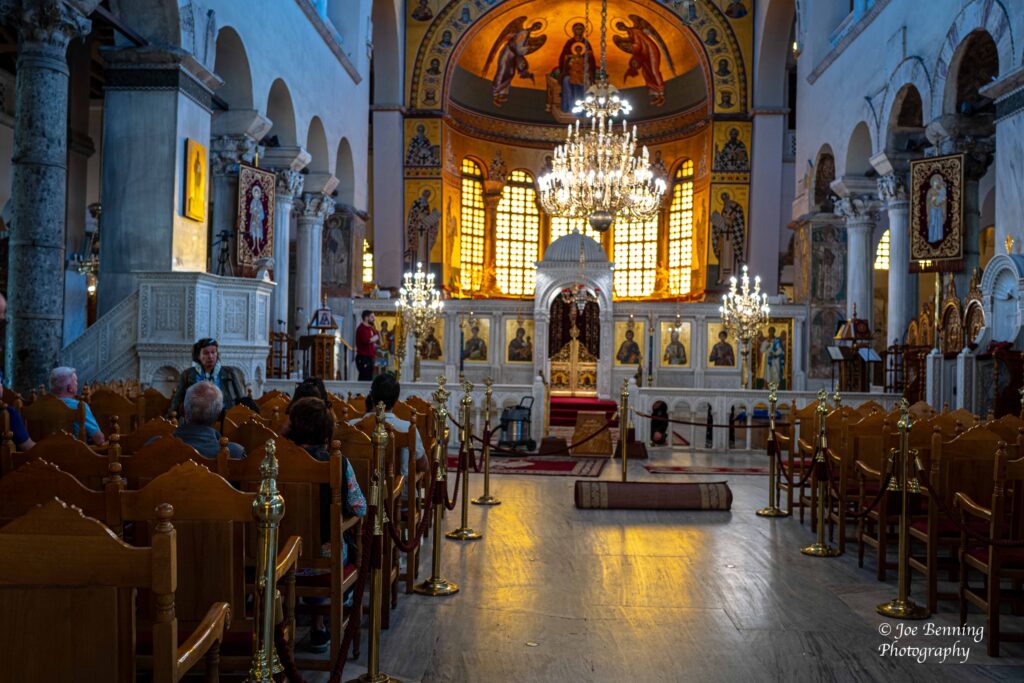
Workers in churches all over Greece were busy on Holy Thursday preparing for Easter rituals and proceedings. Lucky for us, Holy Thursday was the day for our visit to Thessaloniki. We saw many Epitaphios (the embroidered or iconographic cloth depicting Christ after his removal from the cross). A wooden canopy, decorated with flowers, carries the epitaphios in a solemn procession on Good Friday evening.
Volos
After Thessaloniki we headed to Volos, a much smaller town with lots of history (of course). Another visit to the archeological museum in Volos, and then a trip to the nearby village of Milies.
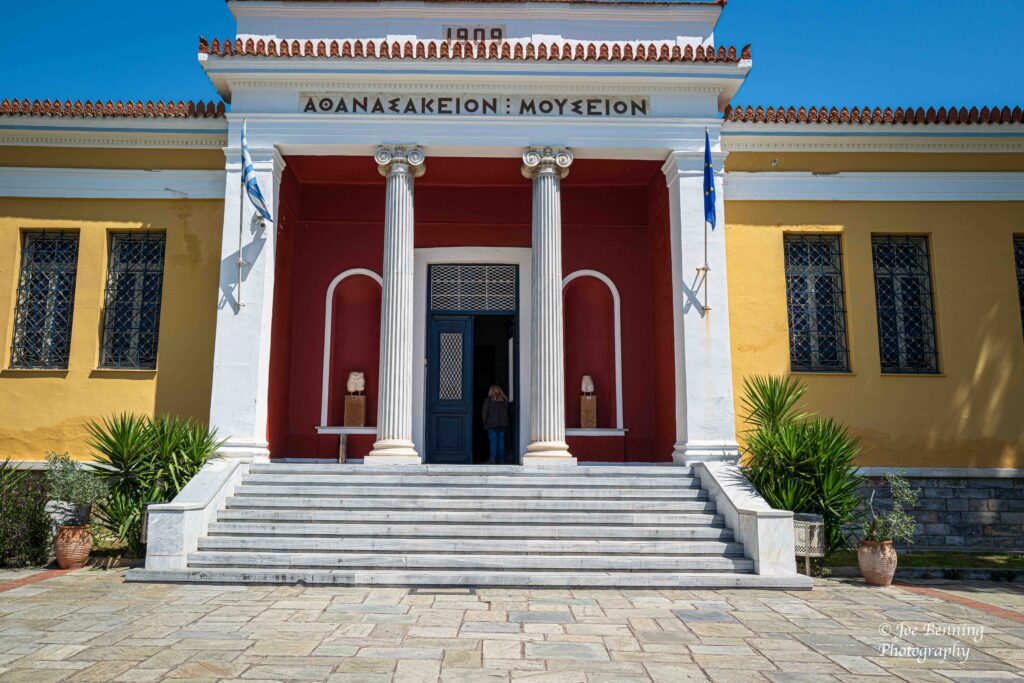
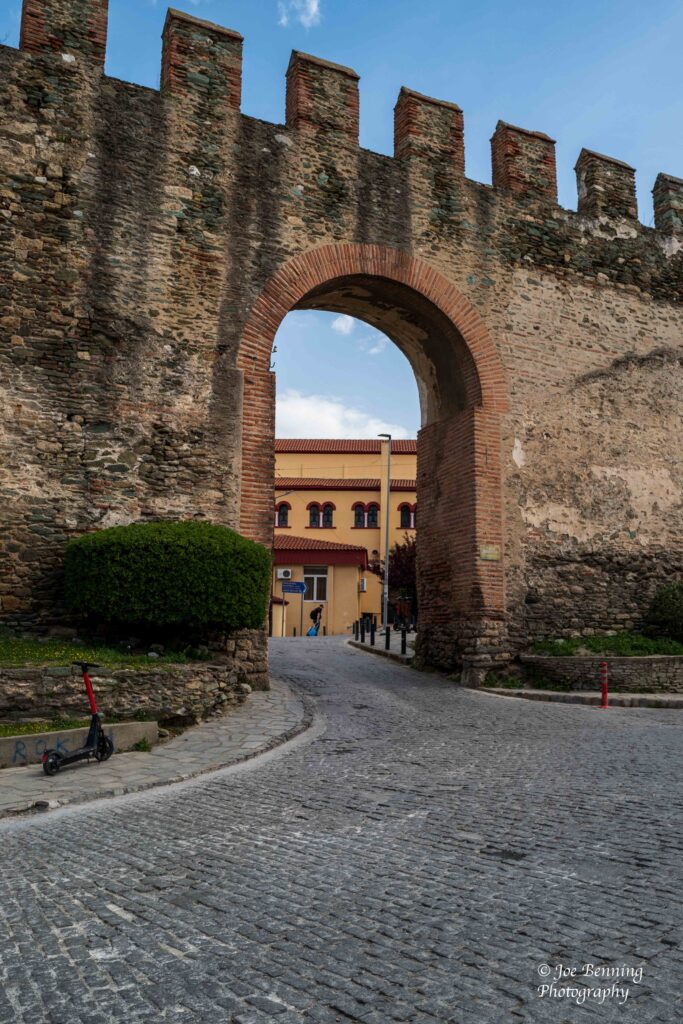
Milies means “apple trees” in Greek, and the region produces beautiful, tasty apples, along with flowers and many other crops.
Milies is one of 24 small towns on the Pelion Peninsula in the Thessaly region of central Greece. These small old towns are hidden high in the hills, because it did not make sense to live on the coast in the days when pirates were attacking coastal cities.
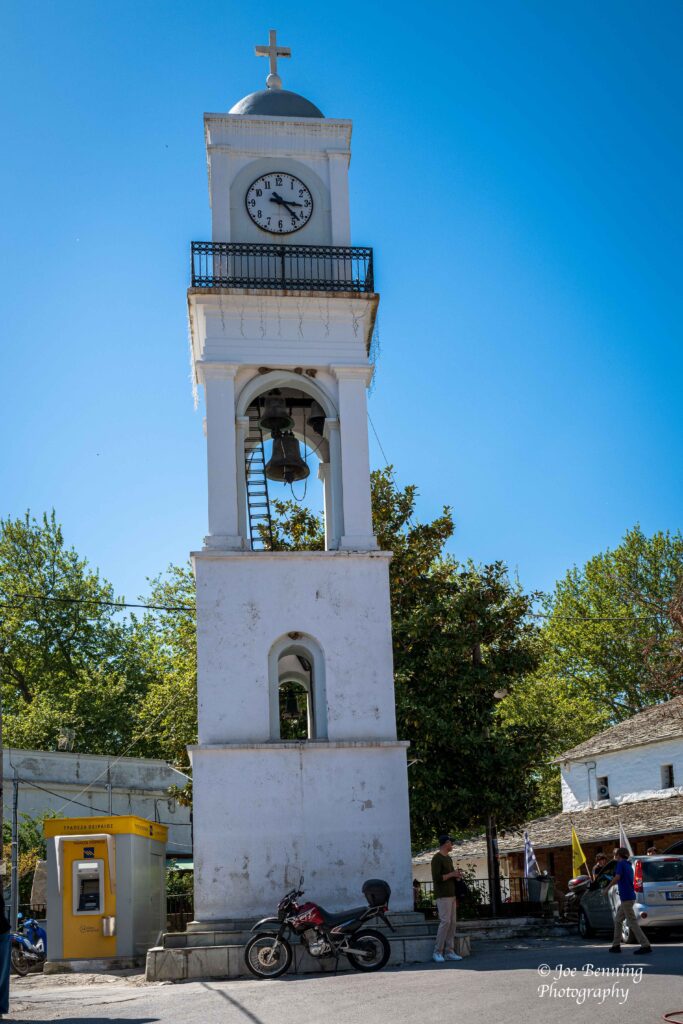
The Church of the Holy Archangels, a Greek Orthodox church, is located in Milies. It is very small but the interior is ornately decorated with many frescoes.
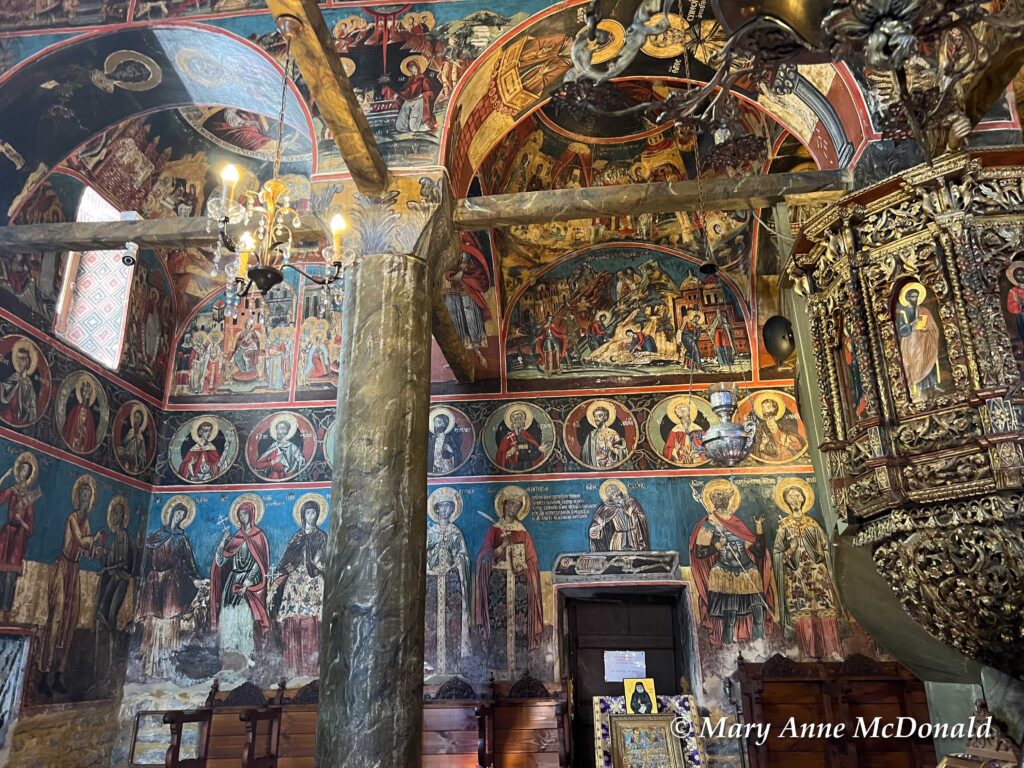
There is a beautiful entry to the church where candles may be lit for special offerings. When we visited the church on Good Friday, the church had another Epitaphios on display. Holy Week is a special time to be in Greece and learn about the Greek Orthodox church. This year is the first time in 1700 years that the Roman Catholic and Greek Orthodox churches will celebrate Easter on the same day.
We plan to go to a Mass on Easter in Athens to be concelebrated by the ship’s chaplain.
MAM & JFB
Türkiye (Turkey)
After two days in Greece, we moved on to Türkiye (Turkey), a country with a unique geographic position and an incredible history. It is partly in Europe and partly in Asia. A ferry shuttles between the two; it’s about a half hour ride. Most of the land mass is in Asia but most of the population is in Europe.
Before arriving in Turkey we studied some of its history, but it is a LOT to absorb; parts of Turkey have been inhabited by humans for about 12,000 years. We did our best to see Ephesus and Istanbul, but 3 days is hardly enough.
Ephesus and Mary’s House
Ephesus (as in Paul’s Epistle to the Ephesians) was a major port city for the Romans in the first century AD. When silt in the river made the port less accessible, Ephesus was moved inland.
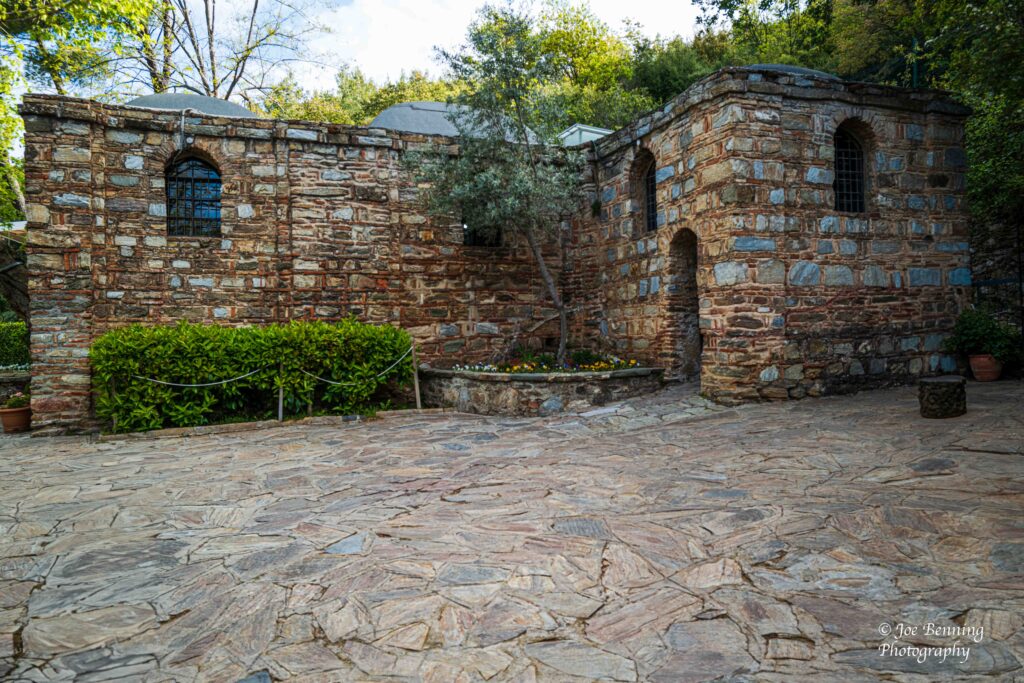
Before exploring well-preserved ruins from the Roman era, we had an early morning visit to the house near Ephesus where the Blessed Virgin Mary was believed to live after the death of Christ. The stone house, located in a large national park, is a simple 2-room structure which now houses a chapel. The morning was serene and the atmosphere very spiritual. It was a beautiful way to start our exploration of Turkey.
We moved on to the remains of the Roman city of Ephesus, walking around well-preserved structures (or parts of them) – the Library, the Odeon, the Temple of Hadrian, the Theater and the Agora.
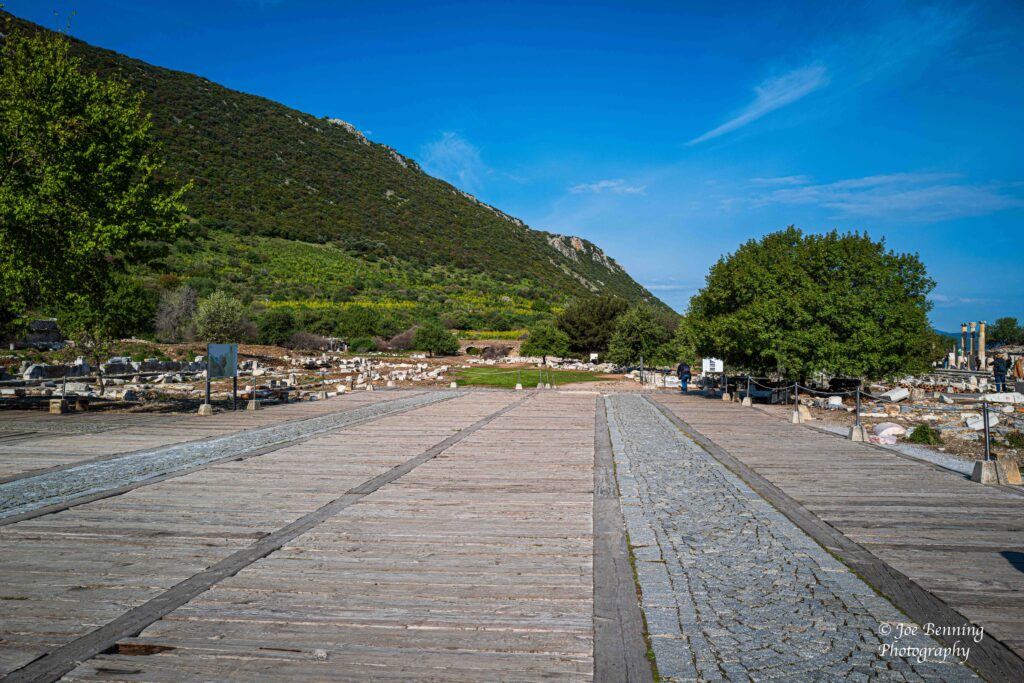
Excavation in this area is quite recent, and approximately 20% of the old City center is now open to the public. There were virtually no limits on accessing the works – you can climb around and stand on pedestals or walk up the steps and enter what is left of the library.
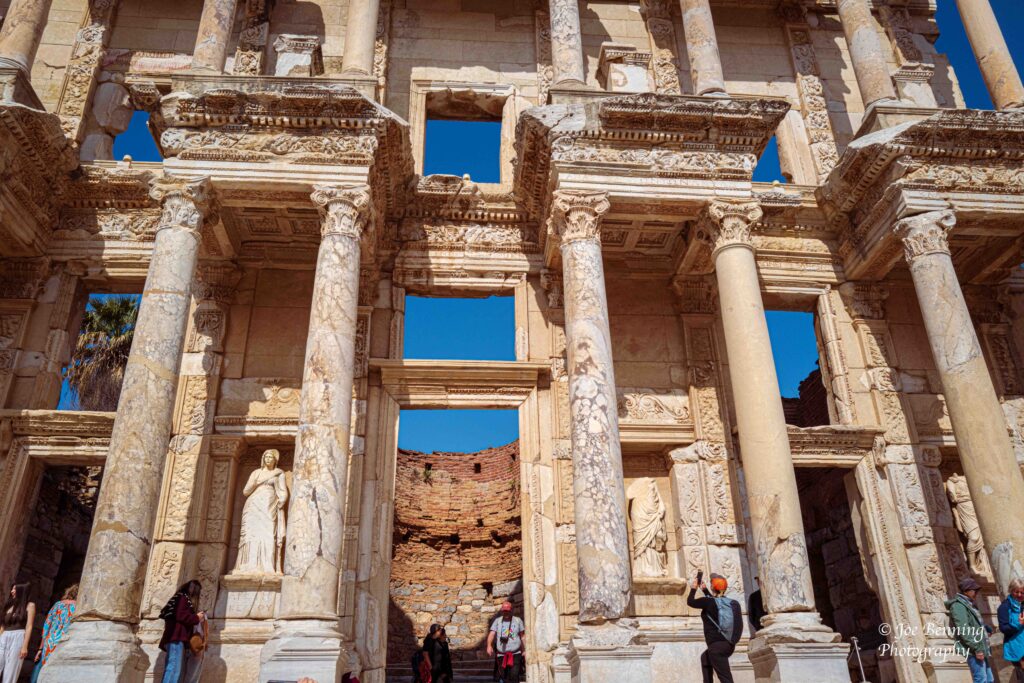
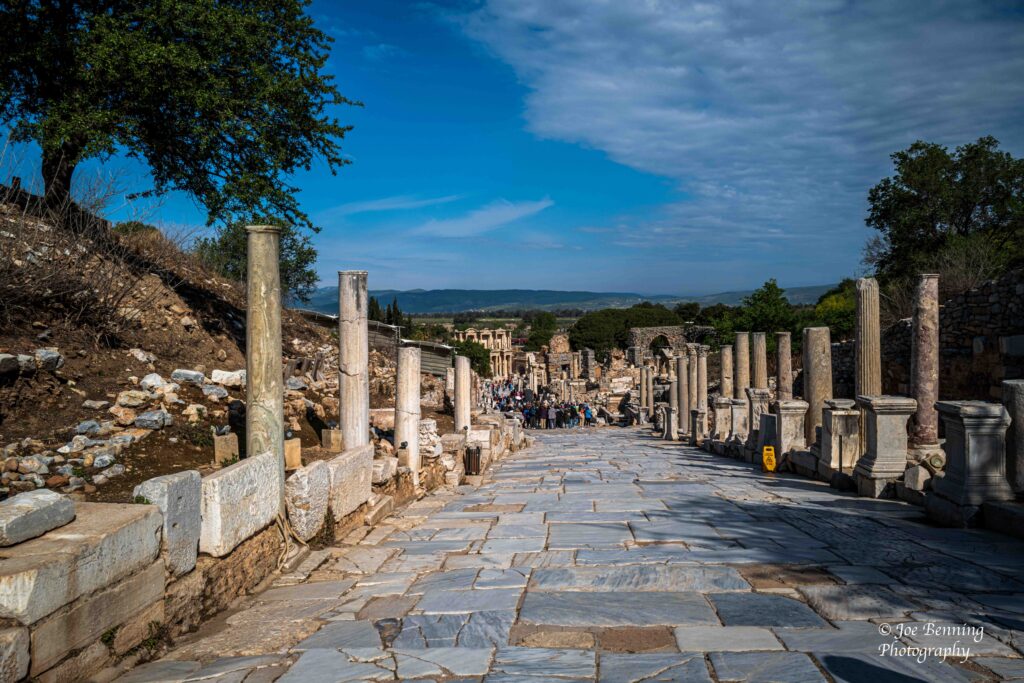
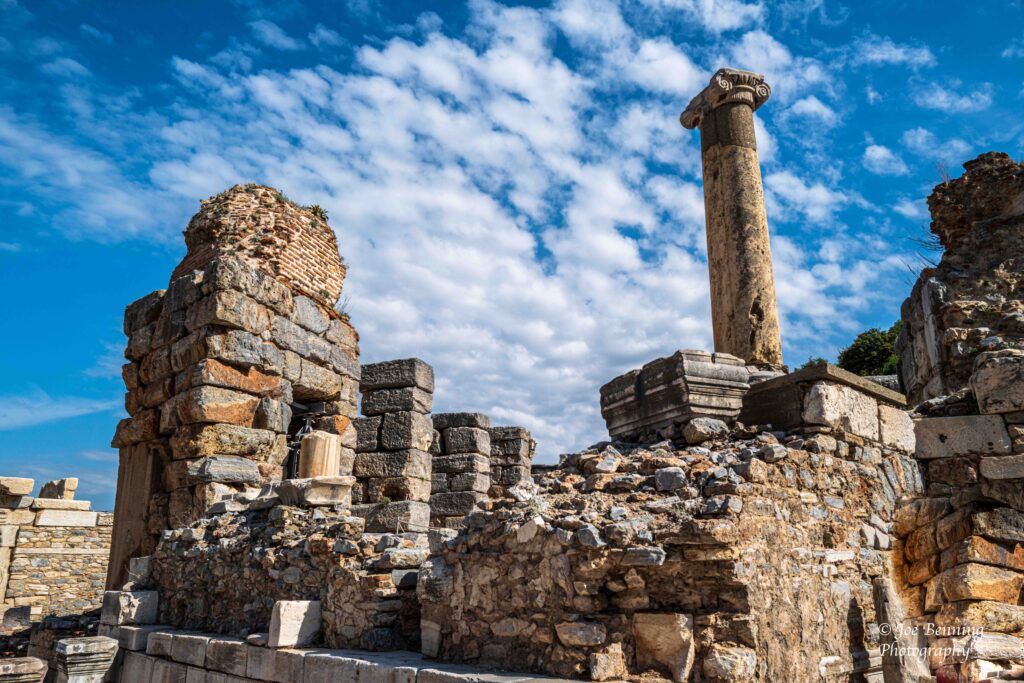
The Ephesians were masters when it came to water and sewers – clay pipes of various sizes allowed for different water pressure, and marble or stone enclosures ensured that when the pipes met at a right angle, the pressure did not cause any cracks. The public health was enhanced by a public latrine system that used running water to remove waste. Very ingenious, those Romans.
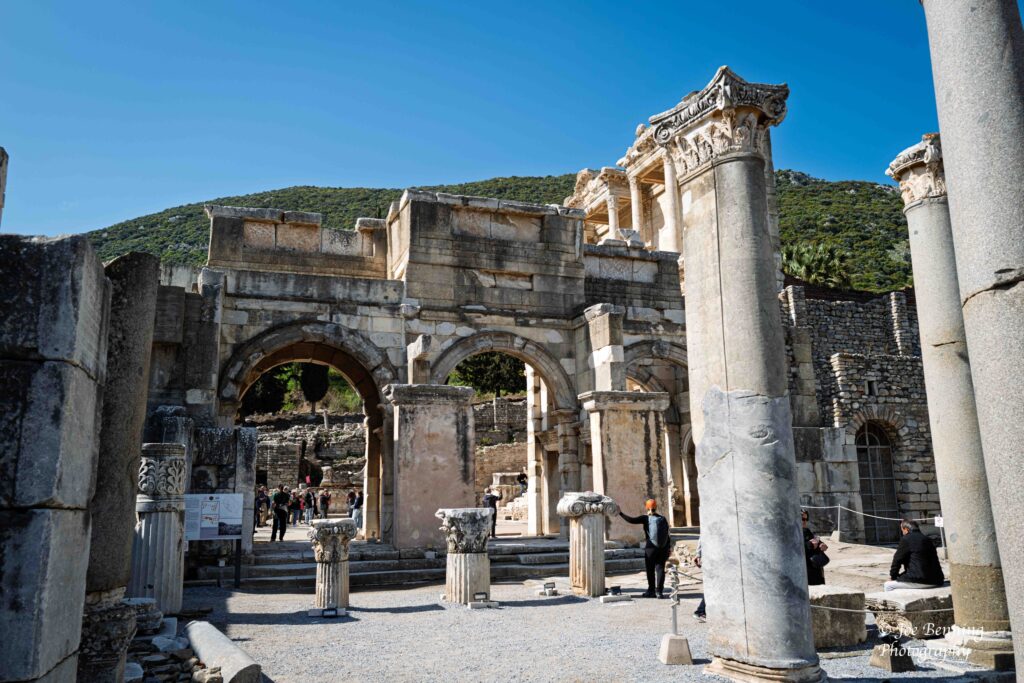
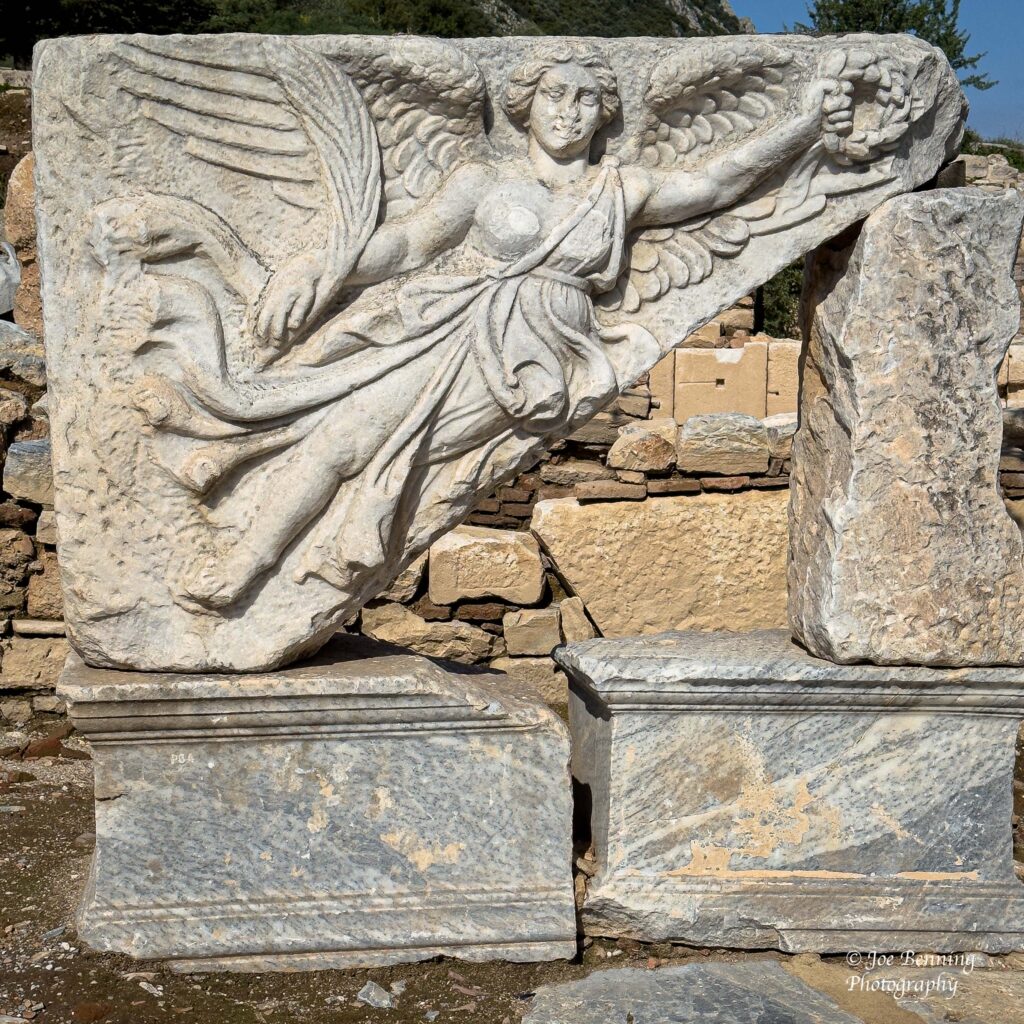
Next stop: Istanbul
MAM & JFB
Rhode Warriors
Our next stop was the island of Rhodes. With a population of 56,000 in the city proper and 90,000 counting the outskirts, Rhodes is the principal city of the island of Rhodes. Built by the Hospitalliers, it is one of the best-preserved medieval cities of Europe, and is designated as a UNESCO World Heritage Site.
One of our first stops in Rhodes was a park that contained remnants of the acropolis where the games were held. Back then the contests concentrated on boxing, javelin throwing, races and discuss throwing. Synchronized swimming had to wait for its day in the sun.
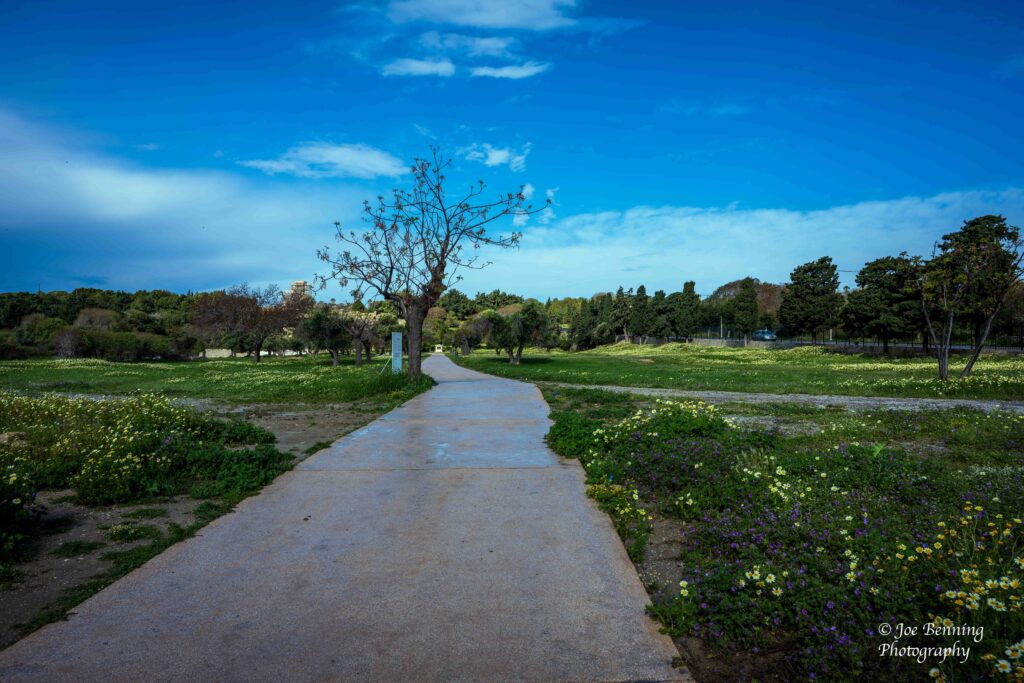
After we walked through the park, we went to view some city ruins.
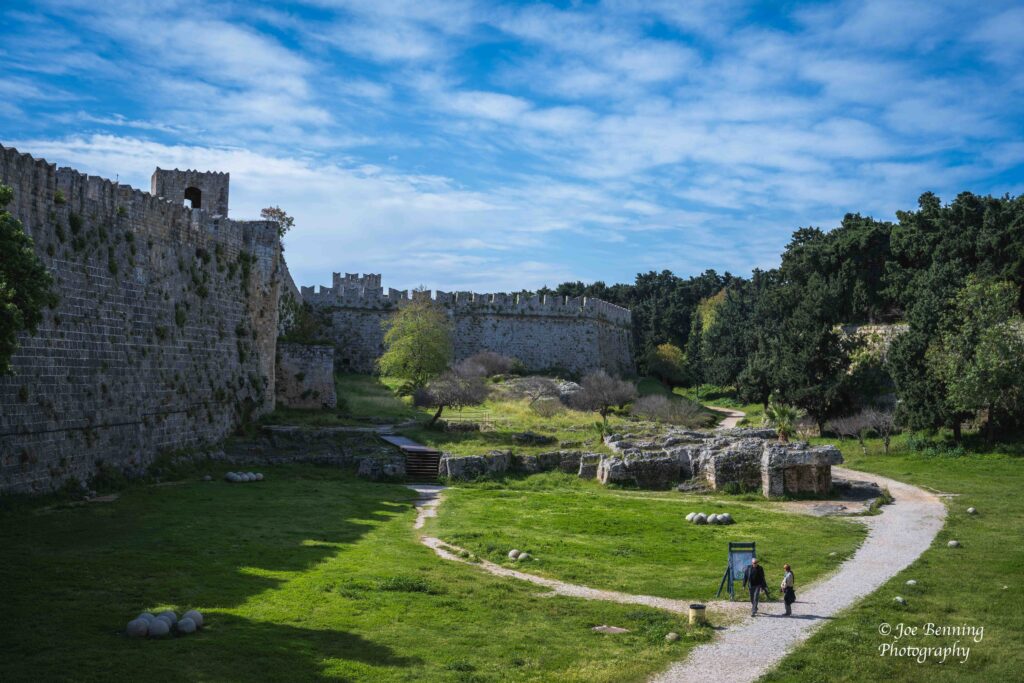
The archeology project that is currently underway to unearth the ruins will be going on for a long time—because there is so much to unearth. Our excellent guide told us that maybe only 20% of the ruins had been discovered.
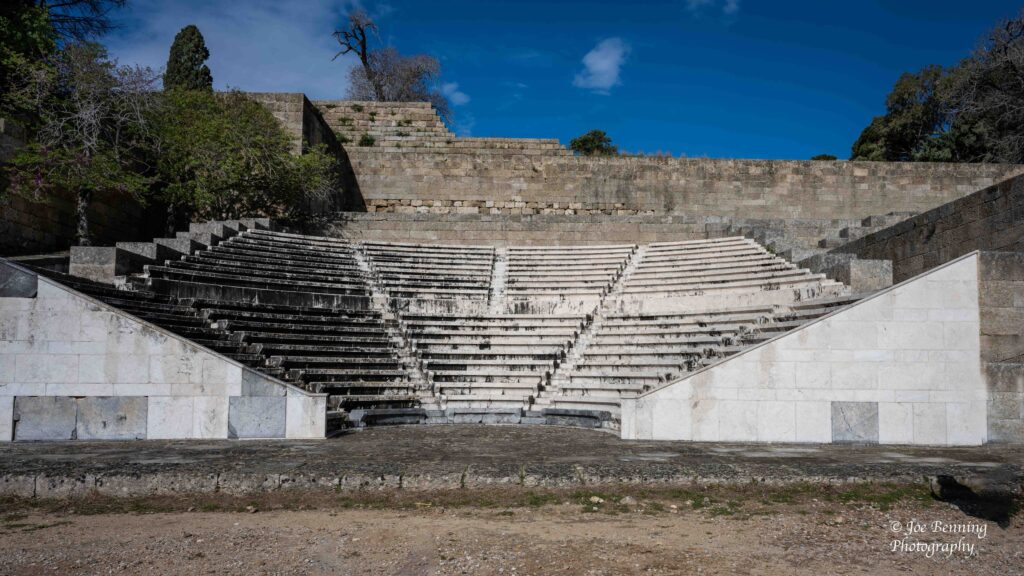
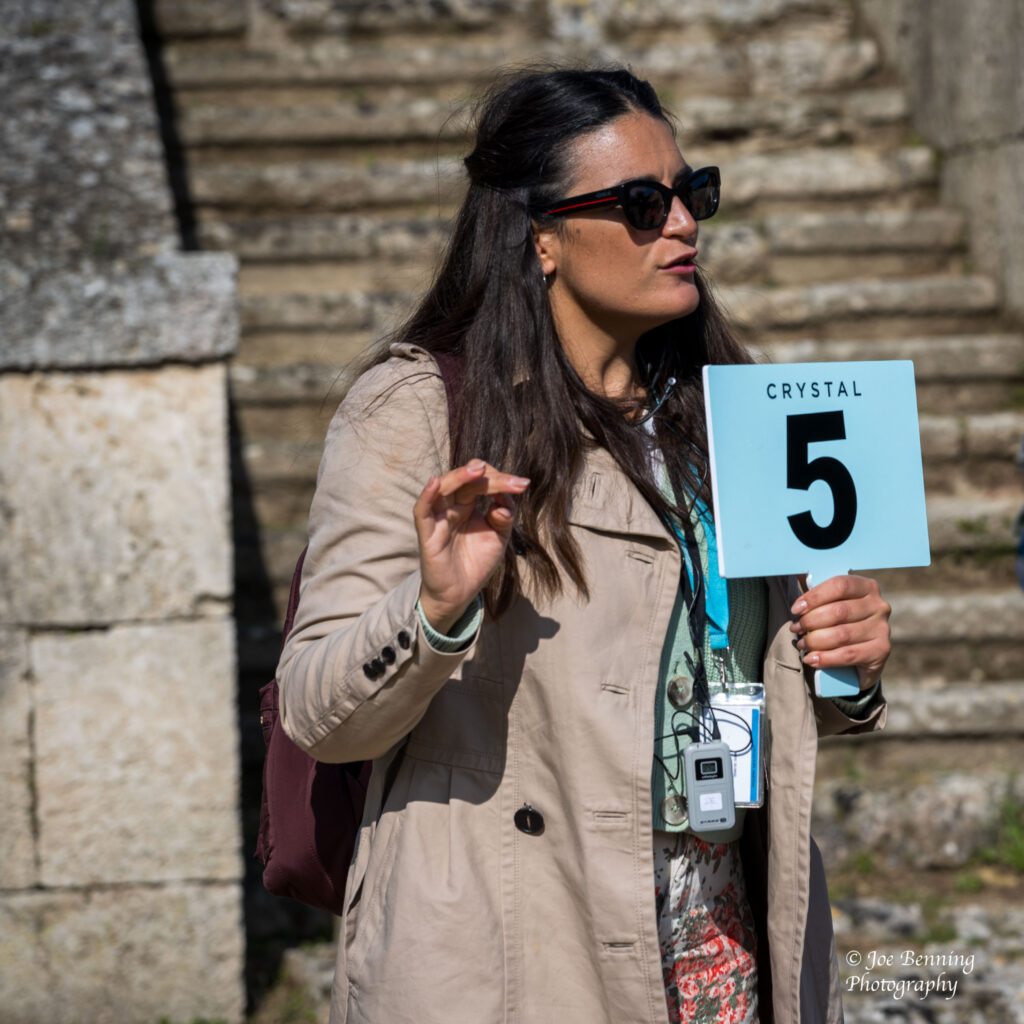
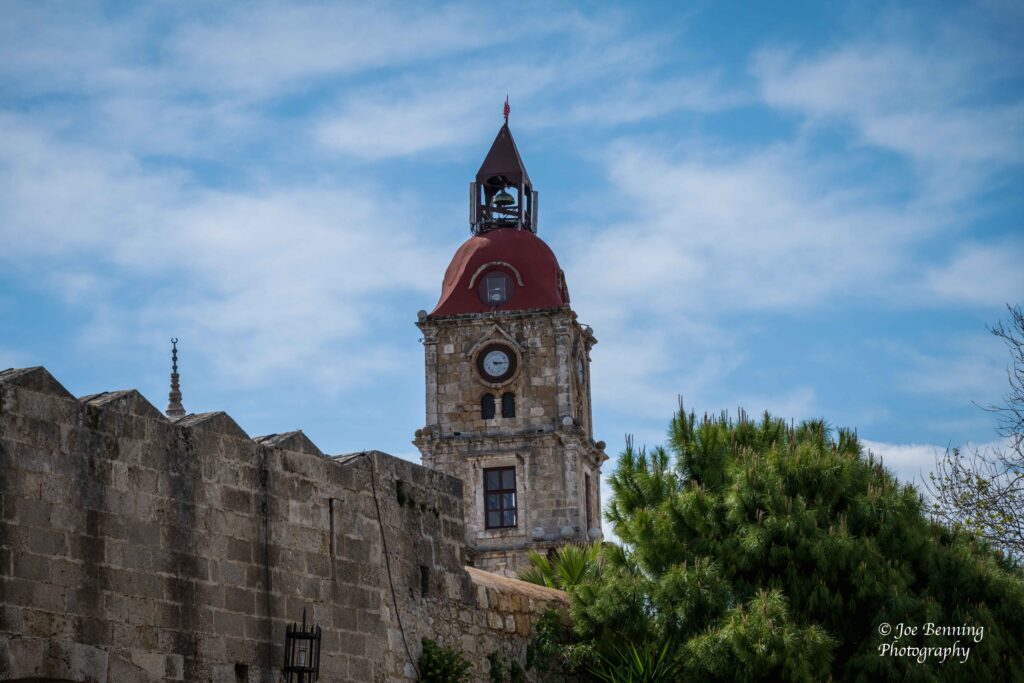
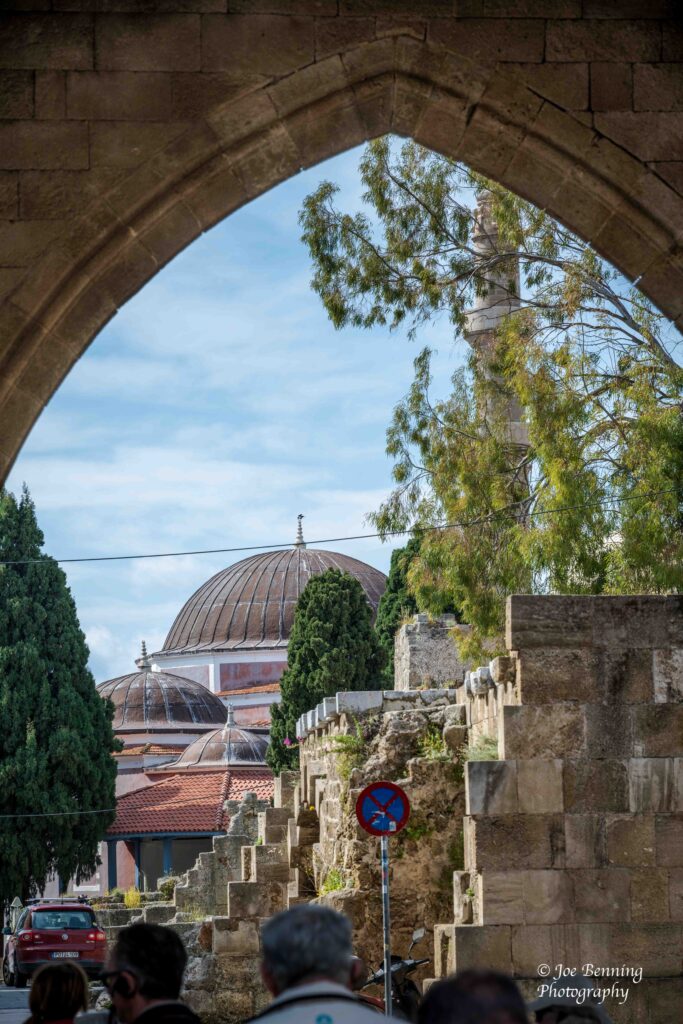
We took a long walk through the Old City and got a reasonably good idea of what it was like behind the city walls, which were designed to protect the city from raiders.
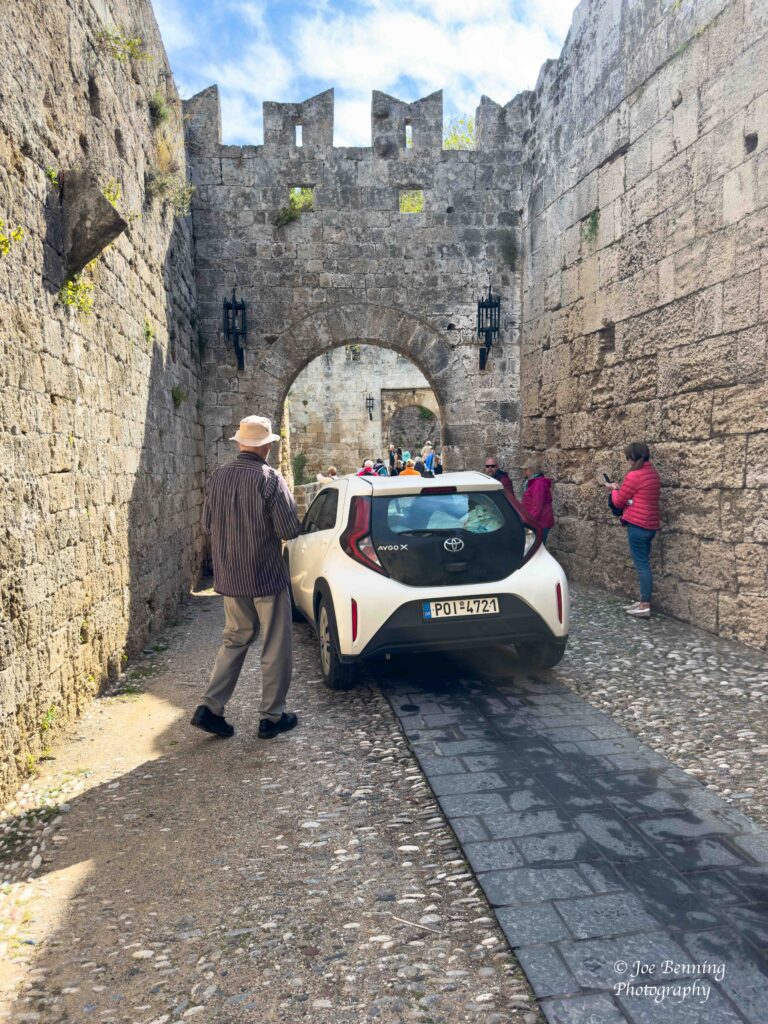
One of the ironies is that people who live in Old Town (and only the people who are permanent residents) are permitted the luxury of owning cars and driving them in the Old City. My guess is that that is largely responsible for the spectacle pictured below, which is repeated many times over on a daily basis.
All things considered, Rhodes is pretty spectacular and well worth a visit, especially for art and history aficionados. Next stop: Turkey or Türkiye as the locals put it.
JFB