Eastern Russia

Eastern Russia April 20, 2016
Just a few hours heading north in the Pacific Ocean and you go from relatively mild early Spring weather in Japan to sub-zero snow in Russia! We visited Korsakov on Monday, on the island of Sakhalin, about halfway between Japan and Russia in this area of the world. This island was settled by the Japanese during the Edo period (approx. 1600-1870), but has been the subject of contests between Japan and Russia since that time, through the end of WWII, when the island was awarded to Russia. Not many people live on the island, and much of it is forested. The island industries include farming, fishing and tourism – this island is a haven for birds, seals and other wildlife, so lots of people come to take in the natural wonders.
The island also holds many Daccha – the summer houses of the Russians. We passed many on our drive – small houses on small plots of land, with vegetable and flower gardens ready for planting when the weather thaws.

We travelled to the capital city of the island (Sakhalin), and visited a Russian Orthodox Church constructed in the “old” way – no nails, just wooden pegs holding the logs together. On our trip we passed many churches, some with the colorful and picturesque onion shaped domes.

We visited the Anton Chekhov Museum, and learned more about this writer (who was also a physician). Chekhov visited Sakhalin in 1890, to interview convicts in Russian work camps; he wound up staying for three months, taking a regional census in addition to compiling the prisoner interviews which ultimately became “Sakhalin Island.”

While in Sakhalin we also visited the Regional Museum, which was established by the Russian population during a period when the Japanese ruled the island, to preserve and commemorate Russian history and its people. The Museum is in one of the only buildings on the island that retains its Japanese style architecture.
After another rough night on the sea (lots of ice and lots of speed to make up for the very lengthy immigration processing we experienced at Korsakhov), we have arrived at Petropavlovsk, one of the most isolated large cities in the world (no roads connect it to the outside world). The captain wasn’t entirely sure we’d be able to anchor and visit this island, as the weather is sometimes too inclement to permit tender service. He told us today that last night “we drove the boat like we stole it” in order to make time.

Petropavlovsk was isolated from the world until 1991, especially during earlier years when it housed Russia’s largest nuclear submarine base and military radar installations.
Petropavlovsk is surrounded with natural beauty in the Kamchatsky Peninsula, a mountainous region on the Bering Sea that is part of the Ring of Fire (the circle of volcanoes that encircle the Pacific). This peninsula has 68 active volcanoes (that’s 10% of the world’s active volcanoes), 5 nature reserves, the world’s densest population of brown bears, and a thriving fishing industry.
While on this part of our journey, we’d learned a bit about Vitus Bering, who founded Petropavlovsk (which he named after his two sailing ships in 1740, the St. Peter and the St. Paul). Bering was a Dane who explored Russia and the Aleutian Islands, trying to ascertain where Alaska ends and Russia begins, or whether they were connected by a land mass. The 53 mile gap that we call the Bering Straits is now the water that separates Asia and North America.
Looks like we’re in for very cold weather for the next couple of weeks, but we hope you are all enjoying the start of Spring, and we will be too, very soon!
Best,
MA

PS – the sad end to our story – the wind at Petroplavask was so strong that the tender boats could not safely get passengers to the dock, so we spent the afternoon on the ship, and most of the passengers were somewhat thankful that we didn’t have to brave the cold wind (you can tell some of us are getting old).
MA’s pix from Japan


now this gal shows my level of athletic prowess!


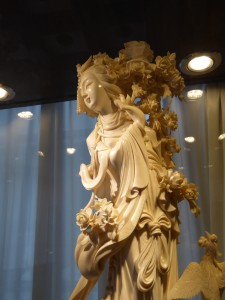
wood artisans and others


Rodin’s Burghers of Calais – one view (there are 57 castings of this sculpture in existence)

Japan (and a little postscript on South Korea)
Japan Friday, April 15, 2016
Our last stop in Korea was Busan (aka Pusan), on the southeast coast, and we enjoyed a long day seeing various sights, including some beautiful beaches. We visited a Buddhist temple perched high on a cliff (lots of steps to get to the top, but well worth the climb) overlooking the sea; the temple dates back to 1376, and at its base is a thriving market with all kinds of food, fish, souvenirs and other items. Joe got some great pictures which he will post when the internet connections allow it.
Busan is another one of those cities where entrepreneurship has allowed for incredible success; in the past 2 decades or so Busan was identified as a great location for movies to be shot; now it hosts an international film festival that rivals South by Southwest, Cannes and other leaders. Busan is currently the second largest city in South Korea, and its largest port city.
In Busan one of the tour guides gave us her take on the political situation, which was the first time we heard it openly discussed during our few days in Korea. She indicated that while South Koreans would like reunification with the North under a democratic regime (or even a nominally Communist rule), that seems less like than ever, given the North’s current leadership.
And one last Korean note: Just as I noted that Tiger Woods was born in Thailand, I now know that Lydia Ko is from Jeju Island, South Korea!
And now we are in Japan – 1 day each in 2 relatively small cities (Fukuoka and Shimizu), and a day and a half in Tokyo – very different experiences. Japan is basically 4 large islands (and 4000 smaller ones), of which 70% is mountain and forest. 130 million people crowd into the small percentage left for commercial and residential use (only 20% of Japan is suitable for building), and the cities and towns are dense. Dense, but orderly and beautiful at the same time.
The Japanese practice 2 main religions, Shintoism and Buddhism. Shinto is an ancient Japanese religion founded on the concept that all natural objects (trees, stones, etc.) have spirits and souls. At joyful human events (birth, marriage, new year’s celebrations, etc.) Shinto rites are observed. Buddhism (which came to Japan from India, through China) is concerned with death and the afterworld; accordingly, Buddhist rites are observed at funerals. Thus the 2 religions co-exist.
During our visits in Japan we saw lots of white medical-style face masks (attributed variously to pollution or to pollen conditions), lots of baseball games, lots of cherry blossoms, lots of shrines and temples and Buddhas, and just lots of people in general. We were impressed with the size of Tokyo, and its many colorful neon signs, but didn’t get to anyplace we would really call charming (maybe on another visit we can see some of the gardens and museums that the city has to offer).
Our visit included time at the Shizuoka Prefecture Museum of Art in Shimizu, and we saw many beautiful Rodin schulptures (the Burghers of Calais, the Thinker, the Gates of Hell, etc.) and some lovely gardens.
Outside of Tokyo lies Kamakura, the seat of government when the Shogun (the Samurai class leaders) ruled Japan. We visited a Great Buddha and saw a few monks and some ladies dressed in traditional clothing, as well as the Tsurugaoka Hachimangu Shrine, founded in 1180 and still in active use by worshippers.
We have also enjoyed some great local entertainment provided by drummers – they are fast as lightning, and perform modern songs as well as traditional ones, in many cases using only drums and no other instruments.
Tomorrow we’ll be in another Japanese town, in the north of the country. We travelled for the past day or 2 into the North Atlantic, and the sun has been out but the weather is choppy – lots of hanging onto handrails while people travel around the ship.
Many of the folks on the ship have traveled out in the past few days to Kyoto and other ancient towns, or have taken the bullet train for the experience, or gone to see Sumo wrestlers practice, or have visited with geishas (hostesses) and enjoyed tea ceremonies. The reports back have been very positive – welcoming local people who are very proud to describe their long history and share their many art forms.
Hope that all goes well with you all.
Best,
MA
notes about Korea so far
Seoul and Jeju Island, South Korea Friday April 8, 2016 8pm
We spent yesterday in Seoul and today in Jeju Island, South Korea. In each place, guides emphasized that Korea is different from China and from Japan. Koreans are descendants of Mongolians, not Chinese clans. Koreans appreciate things on a smaller scale than the way things are done in China (the population is much smaller, of course, as is the land mass). The Japanese took over Korea for a number of years, and the Koreans are glad to have that period over, and to enjoy relative freedom and prosperity today. We heard a lot of discussion about North Korea, much along the lines we hear in US news reports.
We saw a secondary palace yesterday, the Changdeokgung Palace. This was not the king’s major residence, but rather a place for his concubines and a getaway spot for him. It’s tucked among the busy streets of Seoul, near to residences and high rise office buildings. You’ll see from Joe’s pix that it is modest when compared to the Summer Palace or the Forbidden City in Beijing – smaller, less ornate, quieter.
We spent the afternoon out in the sunshine on a nice warm day exploring the Hwaseong Fortress – we only walked a part of the wall, but it runs for 4 miles, and has numerous guard towers, observation towers, and platforms for archers to rain arrows down on those who might try to attack the town within the fortress. One unusual thing about this Fortress is that it was completed in 3 years (by 1796), and the laborers were compensated (not usually the case). Visitors were encouraged to try archery, and to learn from their efforts at the sport – look within yourself to identify ways to improve your performance, and don’t place the blame for error elsewhere.
Seoul as a city reminded us of New York and other major cities (it’s home to millions and has been the Korean capital for a very long time). There are many high rise office buildings with logos you’d recognize (not just Sansung or Hyundai, but also Citi and other western firms). Lots of construction going on, and very vibrant.
Today we are on Jeju Island, the southern tip of Korea – it’s a beautiful island with rich soil from the volcanic ash, and many crops are grown here (tea, carrots, garlic, potatoes, barley, and 40 species of Mandarin oranges). We visited a lovely bonsai garden with waterfalls, pools and stone sculptures (the Spirited Garden) and read about the philosophy of its creator, how tending these miniature plants teaches us how to live: be patient, work hard, trim away what we do not need and what makes us bad (greed, envy, etc.), learn to appreciate nature and people who are different from us, etc. The various areas of the Garden have great names: the Welcoming Garden, the Soul Garden, the Inspiration Garden, the Philosopher’s Garden, the Peace Garden, etc. It was a very serene spot, and there were no crowds – quite a difference from China.
We also visited Jeju Island’s largest tea plantation, and viewed beautiful rows of tea plants, lined up almost like vines in a vineyard. It was mid-afternoon when we left, and lots of parents with schoolchildren (in their uniforms, just like ours were when we were 10 years old) were arriving to enjoy the area.
We have more of Korea to see tomorrow, but are really enjoying the philosophy that is embraced here – hard work but a search for understanding and calm. We were interested to learn that in the 1400s during the Joseon Dynasty, the leader created a new alphabet so that more could become literate. Instead of the complex Chinese system of characters, new letters were grouped into syllables that were easy to learn.
Hope that you are all doing well. We’ll be back in NJ in just about 4 weeks – hard to believe!
Best,
MA
why the Summer Palace in Beijing reminds me of Spring Lake


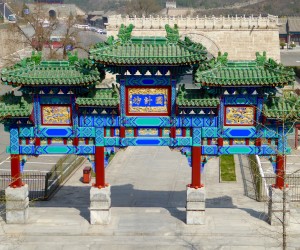
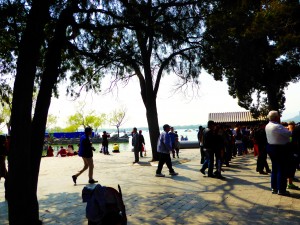
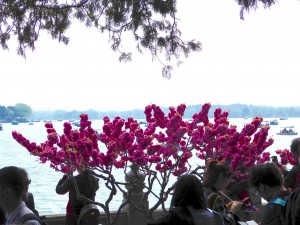
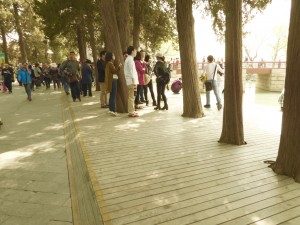
MA’s pix from Beijing – not great quality but my goal was to give you a sense of scale


3 days in Beijing
Beijing, China Wednesday, April 6, 2016
The bottom line, if you don’t want to read further, is that this is just about the biggest place we have ever seen – more people, more land, more buildings, bigger buildings, more of everything than we ever could have imagined. We cannot even begin to explain the history of China or of Beijing, but suffice to say, it’s long and complex (kind of like this post turned out to be).
We departed Beijing last night (Tuesday ), after spending 3 days viewing as many sights as we could. Sunday (the day we landed) started a three-day national holiday, the “Sweeping of the Tombs.” This is a major holiday here where the dead are honored, and many Chinese use this time to take a family holiday, so Beijing was especially crowded as it is a major destination for Chinese visitors as well as foreign visitors.
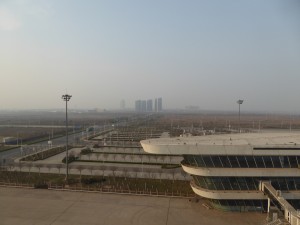
The port where we docked seems to go on for miles and miles, and it probably does in reality – I have never seen so many container or cranes and other loading equipment – as far as the eye could see, and then some.
The cruise line organized this Beijing trip for 700 of the passengers – a miracle of logistics. We found it funny, but kind of reassuring, that an ambulance actually accompanied the 24 buses that got people around to various sites (not one ambulance per bus, but one ambulance when all of the buses were going together to a site). Apparently someone fell at the Great Wall a couple of years ago and broke a leg, so now the cruise line plans for an ambulance to join the crowd when we are all headed in the same direction. It seemed generally that about half of us visited some sites and half visited others on Sunday, and then we switched on Monday. A lot of folks had been to Beijing before so they didn’t join the organized tour but went out on their own. Very brave when the street signs are not in the Western alphabet and many local folks do not speak English.
On our way Sunday morning from the ship into Beijing (260 kilometers – a 3 hour trip if there is no traffic), we passed a large cemetery where the Sweeping of the Tombs was being celebrated – every tomb was decorated with vibrant flowers, and families were celebrating and setting off fireworks, etc. Very festive and respectful in a culture where ancestors are worshipped.
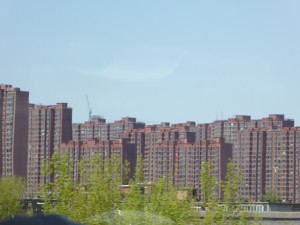
But the real news on Sunday was that a trip from the port into the city takes 3 hours on a good day – this gave us an inkling of the size of the city and the country, the number of people, and the scope of it all, which is just amazing. Early on during that ride into the city I started taking pictures of the incredible housing projects that I saw – very tall apartment buildings that popped up in clusters of 20 or more. After about 20 minutes I couldn’t take any more pictures – it was overwhelming how many residential units there are, how many roads there are, how much construction you can see as new places go up, how many trees and shrubs are being planted by those roads, and how I had never seen anything on this scale – and this wasn’t even close to the heart of Beijing. I learned later that Beijing actually has 6 ring roads, and I guess when a city is 6500 square miles that is what you need.
Beijing is one of China’s ancient cities, and it started off as a much smaller place, with a large wall around it, a moat, several watchtowers and a bell tower (to let people know when the city gates were about to close), and all those nice old touches.
Beijing is now the national center of politics, economics, education (over 500 universities!), culture, trade and communication. Approximately 20 million people reside in Beijing, and I think at least a few million more came in for the long weekend.
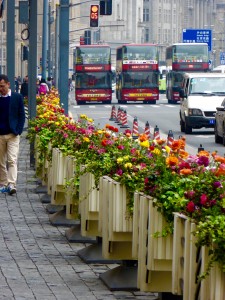
As we went around central Beijing in a tour group arranged by the ship, I saw traffic circles that looked as pretty as Park Avenue NYC looks in the spring (flowers everywhere), but there were 6 lanes of traffic in each direction in the Beijing intersections, and lots of cars, trucks, motorcycles, motor scooters, bicycles and pedestrians in those traffic circles. A bit chaotic but everyone seemed able to negotiate it very well.
You may recall that Beijing hosted the 2008 Summer Olympics, and built new large stadia and venues for the events. Good thing, since they will also be hosting the 2022 Winter Olympic Games.
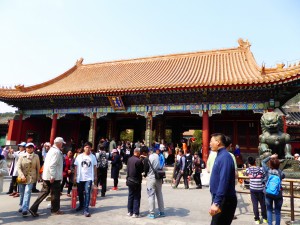
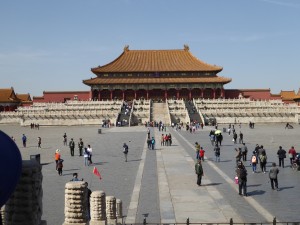
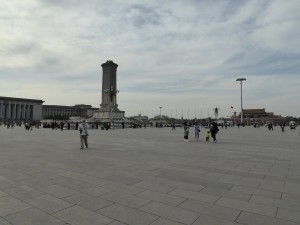
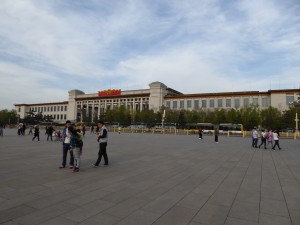
On Sunday we saw the Forbidden City and Tiananmen Square – Joe got some great pix and I tried to get some that show the scale of these places – just enormous. Tiananmen Square is a large plaza where “the people” could assemble when the Emperor wanted to address them. It is just across the street from the Forbidden City, and the Great Hall of the People is on one side of the Square while the Museum is on the other.
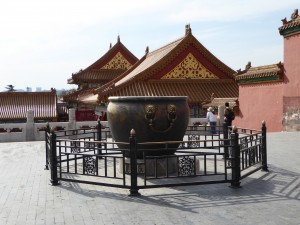
The Forbidden City is surrounded by a moat and a wall 10 meters high. Once inside the Forbidden City, we saw many public buildings that were on the outer perimeter, where “the people” could muster. Inside of that were large courtyards and buildings in which the Emperor conducted official business – buildings for visiting dignitaries, buildings for the staff, etc. And then after another large courtyard you get to the buildings for the household goods and the food, and then to the Emperor’s residence, and then to the Empress’s residence, etc. We tried to capture some of this in the pictures, but it is hard to describe the scale of this, and I am not sure the pix will do it justice.
The Forbidden City is where 24 Emperors held their imperial palace, and it covers 180 acres (with over 8700 rooms) – there is a very large park (Imperial Park) at the end of the City, with the traditional water features, stone work, and greenery. In the Forbidden City, the government limits visitors to 80,000 day max – a LOT of people.
Tiananmen Square (109 acres) is the biggest plaza we have seen in a city – and on Sunday it was full of visitors. Quite a different place than the photo that we saw in 1989 with tanks lined up and a lone student in front of them protesting. We saw the kind of scene you’d see at any park on a weekend – lots of families with children, having a great time in the sunshine.
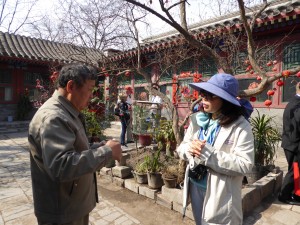
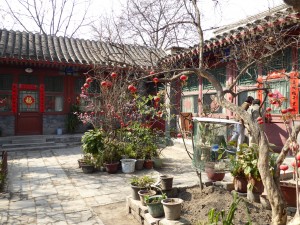
Monday we visited the Hutong – the traditional housing in this area – houses built around a quadrangle for a family (3 generations, usually) to reside. These areas are being demolished over time to make way for more dense housing, but there is some thinking that it’s beneficial to keep these “lane houses” to show how things were in times gone by. We spent some time with one of the house owners to hear the history of the family and to learn how things have changed over time. Given the political changes over the ages in China, suffice to say that it is complicated – if I got it right, the land is now owned by the government but the buildings are privately owned, although the land and buildings were taken from the Emperor and his staff in the People’s Revolution. We’ll have to see if the future holds a place for greater private property rights.
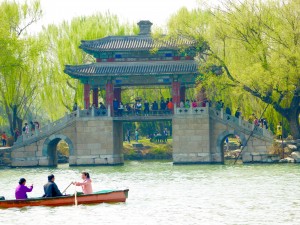
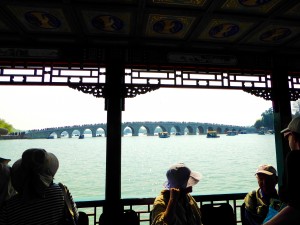
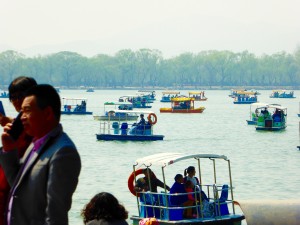
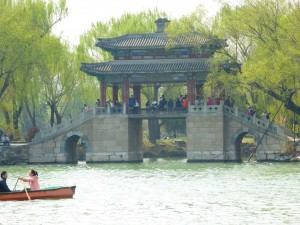
We also visited the Emperor’s Summer Palace – a gorgeous place around a man-made lake of some size. The names of the various rooms in the Summer Palace were wonderful – the Hall of Longevity and Happiness, The Palace of Compassion and Tranquility, etc. We were able to take a little ferry ride around the lake, to observe some of its pavilions, halls, temples, bridges, etc.
I’ll do a separate post on the many ways the Summer Palace reminded me of Spring Lake.
Monday night we were treated to a special performance of traditional Chinese works at the Great Hall of the People, which is adjacent to Tiananmen Square – this is the building where the government officials meet, and where foreign dignitaries are met. It is a building that holds 5000 people in its main chamber, and additional thousands in its adjacent chambers. Can’t say that I have ever seen a hall so large or a stage so high.
At the Great Hall, we enjoyed a delightful performance of Italian opera pieces, acrobatics, children’s song and other traditional dance and song – just incredible. When we left the performance we walked out to Tiananmen Square and the streetlights made a beautiful romantic scene along the wide boulevards (just sorry that I didn’t have a camera because it was a public building with high security). And on a modern note, one guest who left the Great Hall because he wanted to get back to the hotel took an Uber car and was happy to report today that it cost under US $3.
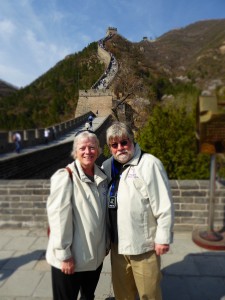
Tuesday was time for the Great Wall – I think Joe’s pix will do all the talking for this, other than to say that the Wall was built to protect China from invaders are Mongolia and other areas, and took 2000 years to build. It’s over 13,000 miles, and much of it is broken up, while some of it has been restored (like the place we saw today). The scale of it is hard to describe – it’s high on the hills (and there are a lot of mountains west of Beijing), and it runs along those mountains with lots of paths down the hills, and lots of towers where those who used to keep watch could use smoke to warn others along the wall of a problem/intrusion/etc.
After the trip to the Great Wall we headed back to the ship (another 3+ hours) and that’s when the weather allowed us to see the smog for which Beijing is known – it was a grey soup that limited vision and made my eyes smart. We were fortunate to have missed it during our days of touring the area.
So this trip to China has been one where we marvel at the creativity and the entrepreneurial spirit of the people, and one where we speculate about the power and strength represented by the structures and buildings Seems like a classic mix of communism (government) and capitalism (economy). It will be interesting to see how the future unfolds for this giant country and its many people.
Pictures will follow from Joe and me.
Wishing you all the best,
Mary Anne

Pix from Xiamen and Shanghai (MA’s pix)


Shanghai, China
Shanghai, China Thursday, March 31, 2016
Greetings from Shanghai! We have spent the better part of two days exploring this City, which has a relatively short but exciting past, and a very exciting future ahead of it. This is our third stop in China – the first was Hong Kong, which is a special administrative region, and the second was Xiamen (pronounced SHAH-men), an active port city on China’s southeast coast.
Now we have arrived at Shanghai, a port just inside the mouth of the Yangtze River (the 3400 mile river that is Asia’s longest and most important river).
Shanghai is China’s largest city, with a population of 25 million (that’s about as many people as live in Australia), and is the 8th largest city in the world. China’s total population is about 1.4 billion, which is over 4 times the population of the USA, and the landmass of the 2 countries is approximately the same.
As you know, China’s history spans thousands of years and includes a lot of invention and advances well before the western world (for example, thousands of years ago, the Chinese had standardized system of measures and a standardized writing system to facilitate trade and communication across the country). As Marco Polo reported on what he found in China, he was considered a lunatic – the western listeners in the late 1200s could not conceive of the Chinese advances he reported (coal, paper, paper money, a dictionary, etc.).
Shanghai was a small fishing village in the early 1800s. At that time, traders from Britain, France, Portugal and elsewhere were carrying on great trade with China, and those in Britain wound up paying their trade debts by selling opium to the Chinese.
In no time at all (so to speak), the Chinese leaders saw the trouble this opium was causing, and banned the foreign traders from China. The Brits convinced their government to go to war with China to re-open the trade (the first of the “Opium Wars”). The first Opium War was ended by a treaty which created 5 ports in China that were open to international trade, and Shanghai was one of them. It was to these ports that many religious organizations sent their missionaries to preach to the Chinese.
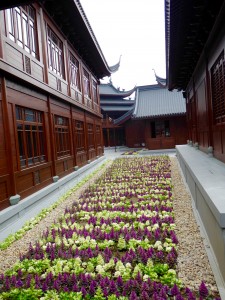
Britain, France, the US and others developed colonial settlements within Shanghai and along the Yangtze River once the first Opium War ended, and the French Concession area is still a highly regarded residential neighborhood in Shanghai (we spent some time there at the Arts and Crafts Research Institute, and it’s a very pretty area). These developments give Shanghai an interesting look – the traditional Chinese areas of the city are crowded and some “lane areas” still are in use as crowded low-grade housing; there are also wide tree-lined boulevards and neoclassical, art deco and other buildings in many areas. Cherry blossoms and magnolia trees line many streets.
The Bund is the spacious promenade on the Huangpu River, which divides old and new Saigon, and flows to the Yangtze. The Bund is the place to be – it is filled with tourists from all over China, and is very scenic.
Today, Shanghai is China’s economic center, and there are large financial service headquarters as well as other commercial towers clustered in the city. The heart of the city is surrounded by large residential apartment buildings – lots of them.
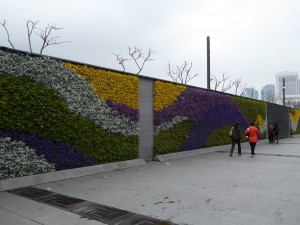
The city is served well by public transportation (cars are not too expensive, but the permits to own them are), and there are more and more parks and green areas appearing in the city with each year.
During our time here we saw some beautiful places, saw lots of people everywhere, and learned some interesting things about Shanghai’s history and culture.
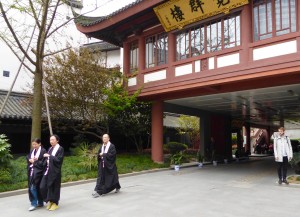
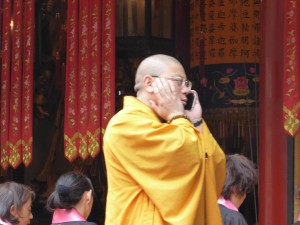
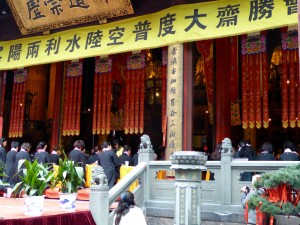
- Yesterday we visited a Buddhist temple and school; student monks and nuns had a service in which they chanted some mesmerizing tunes, while construction crews made a big racket next door to the school. An enormous Buddha made from one single piece of jade sits on the second floor of the school, and gardens are kept meticulously in the little areas between the school buildings.
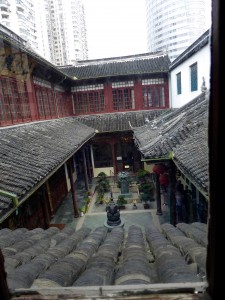
- We also visited a traditional house from old Shanghai days (the Yu Yuan Gardens). It is one of the cultural treasures that wasn’t destroyed as part of the revolution (to Communism); it is a fabulous compound built for a family. There are various structures including 2 areas for performances, gardens and water features, pathways that divide so that the women could take an interior path away from the sun and external world, and other peaceful and beautiful attributes. Immediately outside its perimeter is a giant, crowded, noisy market that looks like Times Square on steroids. Quite a contrast (Joe got some pix).
- Today we took a tour with an architect, and learned that the tower that sits on the bank of the Yangtze River (the Bund) was formerly used to provide weather indications. Jesuit missionaries in the west had a telegraph, and they would telegraph weather information to Shanghai; flags indicating the upcoming weather were flown so that captains could plan their trips accordingly.
- And speaking of Jesuits, they are credited with giving China its reputation as a place for great needlepoint. Apparently the Jesuits provided the fabric for western religious institutions in China, and the Jesuit students did the needlepoint for these items.
- And all those brides we have seen in Australia and Asia so far? No, they are not actual brides, at least not yet. We learned that it is customary in this part of the world for couples to buy or rent several wedding outfits (up to ten), and have their pictures taken in different locations. The pix are then enlarged and displayed at the actual wedding, which is more of a feast than a marriage ceremony.
- And because Shanghai did not require a visa for entry in its early days of growth, it became a refuge over the years for substantial numbers of Jews persecuted at various times in Russia, Germany and elsewhere.
- One tour guide told us about the current dating scene, and related that the one-child policy has created large numbers of parents who are desperate for grandchildren. On weekends there is a corner in the large square where grandparents and parents of eligible-aged young adults gather (in crowds that number up to 800, in her opinion). These grandparents and parents have information available about the candidate, and they exchange information (pictures, height, education, career, assets, earnings, household skills, etc.). If they find a good possible match, they encourage their son/daughter to meet the prospect. Our guide says it’s one of those things where you agree so that your parents won’t nag you, but you just meet for 2 minutes, say hello, and that’s usually about the end of it. (I know, this is a weird story, but when you are stuck in traffic on a tour at the end of the day, the guides might tell you anything just to distract you!)
Sorry for such a long post – I wanted to get in as much as I could remember! I’ll sign off now.
Best,
Mary Anne
Recent Posts
- The American West July 1, 2026
- Yellowstone June 22, 2026
- A Few Side Trips in Portugal May 31, 2026
- Three Weeks in Lisbon May 29, 2026
- Sailing Along the Douro River May 23, 2026
Archives
| M | T | W | T | F | S | S |
|---|---|---|---|---|---|---|
| 1 | 2 | |||||
| 3 | 4 | 5 | 6 | 7 | 8 | 9 |
| 10 | 11 | 12 | 13 | 14 | 15 | 16 |
| 17 | 18 | 19 | 20 | 21 | 22 | 23 |
| 24 | 25 | 26 | 27 | 28 | 29 | 30 |
| 31 | ||||||