Hong Kong


Hong Kong Easter Sunday, March 27, 2016
Greetings from Hong Kong! We are sad to spend Easter Sunday away from family and friends, but we hope you are all enjoying a lovely day.
We arrived in Hong Kong yesterday, and this is some city! It consists of many islands, although only a few are inhabited, and part of mainland China. About 7 million people live in Hong Kong, and 95% are Chinese. However, this is the business and finance hub of Asia, and lots of visitors from around the world come to the city for varying durations. Hong Kong has a large commercial port, and export/import business is big here.
Hong Kong has a lot of history, and it was only in 1898 when it began its modern story. After the Opium Wars (Britain forced China to open up trade, travel, etc.), Britain obtained the right to lease Hong Kong for 99 years. At the time, the area was almost entirely undeveloped and many criticized the chap who signed the deal, thinking it was a bad bargain. But the city grew and prospered, thanks in part to the deep and wide Victoria Harbour between the mainland (Kowloon) and Hong Kong Island. Today it is a clean, modern, sophisticated city.
Control of Hong Kong reverted to the Chinese in 1997, but it is a Special Administrative Region of China, with its own currency and its own rules (at least thus far). And it is a bastion of capitalism like you’ve never seen – luxury merchandise is for sale big-time – think of every fine store on 5th Avenue, Rodeo Drive, Bond Street, or the Short Hills Mall, and that is part of the Golden Mile in Hong Kong.
And wealth is on display in Hong Kong – there are stores selling Baby Dior, Baby Cavalli, Baby Armoni, etc. – and children (and adults) wearing the latest and greatest of every brand (some genuine, some counterfeit).
Add to this luxury plenty of open air markets, markets with stalls, night markets, jade markets, gold markets, and lots of markets for counterfeit luxury items, and that is also part of Hong Kong.
Toss in some beautiful British buildings, pretty parks, eateries of all types, and that is also part of Hong Kong.
Hong Kong has been described as a vertical city – everything is densely packed and built up high – commercial buildings, residential buildings, cemeteries. About 20% of the residents own cars, and the population travels largely by bike, metro/subway or walking.
During our visit here we heard a lot about lucky numbers, fortune tellers, legends of benevolent dragons that protect the Chinese, and feng shui (the consultation of the elements to bring people into harmony with nature). Because construction is going on all over Hong Kong (producing some high rise buildings that are beyond description), feng shui masters are kept very busy.
We heard one story about the construction of a large new skyscraper for a large Chinese bank. The building was designed with many angles and decorative diagonal beams that appear to slash its exterior. The feng shui master retained by that bank advised that the sharpness would inflict damage on a nearby competitive bank. The competitive bank retained its own feng shui master, who advised it to plant willow trees around its exterior, which would make it hard for the sharp edges of the new bank to inflict harm.
Hong Kong permits 3 types of gambling: racing (there is a beautiful old racetrack in town), lottery and football (soccer). Macau is about 90 minutes by fast ferry, and gambling there is thriving.
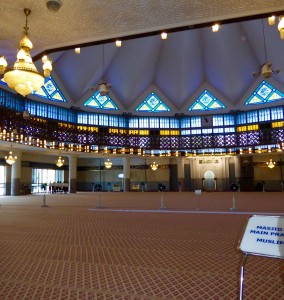
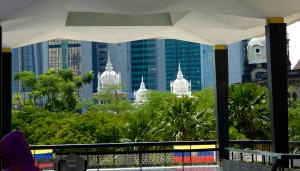
During our visit we enjoyed the skyline (Joe will post pix of this), a nice cruise around the harbor at sunset, a trip to Victoria Peak where you can look down on everything, Repulse Bay, trekking around town and through parks, and walking past the largest mosque in Hong Kong this morning as many ladies in Muslim traditional wear came out of the subway and entered their part of the mosque for prayer.
Joe and I send our best wishes to all for a blessed Easter.
Mary Anne
Central and Northern Vietnam

Friday, March 25, 2016 South China Sea
We spent the last 2 days in central and northern Vietnam – they are quite different from the southern visit to Saigon/Ho Chi Minh City. Da Nang is the large city in central Vietnam, and has a lot of the old colonial French architecture to see, amidst every conceivable type of shop.
We tromped around the Cham Temple ruins on an incredibly hot and humid morning, viewing what had previously been a compound of 70 Hindu temples in central Vietnam, until almost all of them were bombed during the Vietnam War. That visit gave us an appreciation into what the soldiers in the forests of Vietnam were up against in terms of terrain and heat, to say nothing of their enemies.
We also visited Hoi An, an ancient trading city, and saw beautiful temples, lanterns, and silk and other textiles.
Last visit in central Vietnam was China Beach, where American soldiers used to go for R&R; it’s a lovely long beach and within biking distance from Da Nang.
Yesterday we saw some of northern Vietnam when we sailed around Ha Long Bay, viewing the karst formations; karst is formed when limestone is dissolved by running water, creating conical hills with underground caves.
Legend has it that in Ha Long Bay, a family of dragons was sent by the gods to protect Vietnam against foreign invaders when it was a young country. The dragons spit jewels and jade that formed a protective ring of barrier islands, and the Bay has hundreds of these formations to view, bearing names to indicate their shapes (Duck Island, Kissing Chickens Island, Flame Island, etc.). The day was overcast but our trip was not rained out, so we had the chance to see some fishing villages along the Bay, and a lot of water traffic.
In the course of our visits we noticed that the northern and central areas are much cleaner than those we observed in the south, and have better roads and infrastructure. We heard some different versions of how capitalism and communism co-exist than we had heard in the south, and we heard some references to winners and losers in the Vietnam War.
However, all regions of Vietnam appear to be growing in leaps and bounds. Construction is going on everywhere, tourism is booming, and there is a lot of vitality in the air.
Tomorrow we will arrive in Hong Kong (we had our temperatures taken by a scanning device today to be sure that we are allowed to enter China).
Best wishes to all of you.
Mary Anne


Purim and Brussels
What a day it has been;
We started the day with a lecture about ISIS from an excellent journalist, Stephen Cole, who could not have been more vocal about how serious the terrorism threat is.
This afternoon we had a Purim Festival with our ship’s rabbi, with great rejoicing over the feat of Esther, saving her people from the evil Haman.
And then we heard the news from Brussels.
You are all in our thoughts. We hope you and yours are all safe and sound.
MA and JB
Saigon and Mekong Delta, Vietnam
Ho Chi Minh City (Saigon), Vietnam March 22, 2016
Until this week, my gut reaction when hearing the word “Vietnam” was to cringe, recalling the 1970s and how our family sweated out the draft process, worried that brother Jim and his friends would wind up fighting a war. Thankfully our family was spared that fate, but many others were not so fortunate.
Having now spent 3 days in Saigon, I have a very different reaction to the word “Vietnam” and it is a feeling of hope. So many residents of Vietnam are under the age of 45 (and therefore didn’t personally experience the years of war with other nations), so plugged into the world via the internet and social media, and so literate and educated, that this is a society that seems to be going headlong right into a bright future.
While Vietnam is governed by a Communist party, the signs of capitalism flourish in Saigon – all manner of things are bought and sold, and the Vietnam economy prospers from its exports (cashews, coffee, rice, tea, etc.).
However, there are the rich and the poor, and everyone with whom we spoke frequently mentioned the gap (for example, “that’s a building where only rich people can buy apartments”). The tour guides and drivers we met talked often about saving money so that their children could attend good (private) schools and so that their parents could be taken care of (for many, especially non-government employees such as the farmers who have been a big part of the economy in the past, there are no pensions or old-age public health care arrangements, so the children who are now working wind up paying the hospital/doctor/other bills).
Cranes and building projects are everywhere, and the landscape varies from massive construction sites (office parks, factories, residential complexes) along the roadways that lead into Saigon City from the port and outer areas to tree lined boulevards and beautiful parks in the main part of the city, with French neo-classical colonial architecture next door to modern buildings, crumbling old buildings, and virtually anything else you can imagine.
We heard from locals during our visit that although the country is Communist-ruled, freedom of religion (90% of Vietnamese are Buddhists) and other freedoms are the norm; certainly there is freedom from road regulations – more motorbikes, scooters and bicycles that you can ever imagine, flying down roads in all directions, without many traffic lights or other guides, but remarkably low traffic accident rates.
There are 51 dialects spoken in Vietnam, and certainly the country has absorbed a lot of territories in its history. One lecturer on the ship summed up the country’s history this way: The Vietnamese fought the Chinese for 1000 years, the French for 100 years, and the Americans for 10 years. We noticed and heard from locals that white skin is valued for women; ladies generally will try hard not to let the sun make them tan.
During our visit, we saw an enormous wholesale market in Chinatown that looked and operated like something from a hundred years ago, shops on downtown streets that had the brands, look and feel of 5th Avenue NYC, and ladies outside those shops squatting down on the sidewalk cooking waffles over small open fires and selling them to passers-by. We heard that those in Saigon “live on the streets” in the sense that this is where life takes place, and it certainly seems that way. It is a vibrant city, and one we’d love to come back and explore more.
We also took a trip on the Mekong River – a very large river that is the lifeblood of southern Vietnam; it supplies the water for a large area (the Delta) that produces all types of crops. The Mekong River runs from China in the north down through 6 countries; China has dammed a lot of the river and this is affecting the downstream countries and the productivity of the river as salt water from the South China Sea becomes more of its content and affects its use in growing crops.
The Mekong is a muddy brown river, lined with old stilt houses and lean-tos that are still occupied although they look uninhabitable. In some of those old houses there are beekeepers, rice paper makers, wine makers and others who produce items through family labor in what we would call cottage industry – very old-school. We visited a floating market on the Mekong, and learned that commerce on the river is conducted via boat – you either motor/row/sail to a vendor, or the vendor comes to you. Picturesque but not pristine; the river is polluted with trash as are many of the roads we saw.
We are on our way to central and northern Vietnam, and we’ll see if the years have treated this area differently – the capital (Hanoi) has been a capital for many years, and it will be interesting to see if the free market influence is as strong as in Saigon.
Hope that you are all doing well.
Best,
MA

an old art in which the puppets are manipulated by people behind a curtain, who have sticks connected to the puppets to make them move; very skillful work!


Happy Saint Patrick’s Day from Cambodia!
Happy St. Patrick’s Day from Cambodia! March 17, 2016 7pm
We’ve left Malaysia and have now seen parts of Thailand and Cambodia, on our way to Vietnam. What a contrast between Thailand and Cambodia – Thailand prospering, and Cambodia struggling to recover from the atrocities of the recent past.
The 2 countries share an early past, when the Khmer Empire (Hindu and Buddhist, combined with traditional beliefs such as animism) was the dominant civilization in the area. In 1238, the early Thai overthrew the Khmer leaders, using their prowess in growing rice to gain power. Over time, Thailand maintained its autonomy by trading out parcels of land to western countries which wanted to colonize the area (Cambodia and Laos went to the French while parts of Malay went to the Brits, etc.).
In more recent times, Thailand has continued to be independent (although it has aligned with various powers in the world wars). And though Cambodia is also independent today, its role in the 1970s left it scarred. In Cambodia’s earlier days (12th century), magnificent temple complexes such as Angor Wat were built, and a highly civilized society existed. But Cambodia had its share of trouble fighting off the Thais and Vietnamese, and spent some years as a French protectorate.
Communist Khmer Rouge rebels seized control of Cambodia and installed a regime led by Pol Pot in 1975. Almost half of Cambodia’s more accomplished citizens were massacred as Pol Pot tried to bring the country back to “Year Zero” as a completely agrarian society; all western civilization’s progress was subject to destruction as towns were emptied (city citizens were told to leave their homes in one day and relocate to the countryside), educators and the educated were killed, religion was banned, land was confiscated, money was forbidden, media were silenced, children were sent to work camps, etc. Over the course of 4 years, it is estimated that 3 million Cambodians were killed by the Khmer Rouge (approximately 25% of the population). The Khmer Rouge finally signed a treaty (the Paris Peace Accords) to end their reign of terror in 1991.
Now Cambodia struggles to bring its 15 million people out of poverty, improve low literacy rates, stimulate tourism to its beaches, recover and redevelop large areas of rubble and trash, develop the oil and natural gas deposits under its waters, and increase trade through its port. Sanitation, health care and education systems are fairly primitive, and we saw several victims of land mines from the Vietnam War era begging in public markets and shrines. The future can’t get here fast enough.
Thailand (the “Land of Smiles”) is a constitutional monarchy with a population of 65 million who adore their King, a former Buddhist monk and a saxophone player of some repute – road signs and flags abound proclaiming long life to the King, who is in his 80s now. Thailand has lots of natural resources and exports (silk, rice, coconut, palm, tapioca, sea salt, fish, fruits). It’s a Buddhist stronghold (95% of the population and home to 300,000 monks), and has an established and thriving tourism base.
Thailand’s government that often winds up in the hands of the military when the farmers and small business owners (the “red shirts”) clash with the elites/monarchists/judiciary/military leadership (the “yellow shirts”).
Bangkok is called the Venice of the East due to its old system of canals (before cars and motors, trading was conducted via boats that roamed the canals selling their goods to those on the shores). Canal markets are still used in Thailand. Many temples and shrines can seen in the cities, mixing with old and new buildings and resorts.
Yes, the story of Anna and the King is true. It’s based on the writing of Anna, who was brought to Siam by the King to teach his children; he valued literacy and education, and appreciated western thought. But Anna’s book was deemed disrespectful, and is banned in Thailand.
So we see again how old and new mix – learning is valued, but so is respect of the past.
Wishing you all a very happy St. Patrick’s Day!
Best,
MA
some of Singapore’s architecture


notes about Singapore
Singapore Sunday, March 12, 2016
Joe has been to Singapore a few times while working, and always had favorable impressions of the city (it’s a city/State actually), so he was eager to return after 10 years away. Well, safe to say, Singapore has prospered and become even more enjoyable since his last visit.
First a bit of history that hopefully sets the stage: In the 1700s the British East India Trading Company was one of many trading in the Strait of Malacca and nearby places. Britain purchased Singapore (the island at the southern tip of the Malay peninsula, about 250 square miles) so that trade through Asia could be chartered through the BEITC.
Sir Thomas Stamford Raffles was the administrator for the BEITC, and he organized Singapore by setting out a plan of roads, trade routes and neighborhoods where locals of different origins could reside (a Chinese area, an Indian area, a Malay area). The Raffles Hotel which still bears his name (as well as many roads in the city) are a testament to his planning acumen and vision).
Raffles’ stroke of brilliance was in designating Singapore as a free port – no taxes were paid on trades here, and rival ports which imposed taxes suffered as Singapore grew. By the end of WWII, Singapore was a British colony, and this heritage is still evident, even in the perfect Queen’s English spoken by residents.
So, Singapore prospered, but it became a messy place. Enter “Harry Lee’” in the 1950s. Lee Kuan Yew was brilliant local guy who had a vision for Singapore – Lacking in natural resources, Singapore would have to figure out a way for its people to make its destiny by providing value to others. Harry urged Singapore to gain independence from Britain (which it did), and become an industrial powerhouse. He said, essentially, that Singapore needed to become a first world nation, not a third world nation.
Under Harry’s leadership as Prime Minister, Singapore reclaimed land and build up swampy areas so that businesses and residential areas could be formed. His government (Singapore became independent in 1956) offered incentives to businesses to build plants and employ people. Petrochemical and bioscience companies came to Singapore, and the government offered scholarships to students from other lands to study in Singapore (a period of service after graduation was required, and many students stayed even longer). The population enjoys a 97% rate of literacy, and English and Malay are the national languages. Military training is compulsory for males from age 18 on (reservist style training until age 40).
Many regulations were imposed in prior years to govern conduct, and taxes for violation were imposed (no tossing of cigarette butts into the street, taxes for failing to send children to school, no littering, etc.), and these continue to this day. Singapore is a place today where you get in a line for a taxi at a taxi stand, with no one running ahead of you as you might find in NYC or elsewhere. When a pedestrian crosses the street, the turning cars just wait until there is no one in the intersection. It’s very civil and calm.
There are 2 casinos in Singapore, but the government discourages gambling by locals (a local must pay $100 to go to a casino, but it’s free for those from outside Singapore).
So today we have an island that is largely Chinese (75%), then Malay, Indian and other folks making up the balance. While religion still defines many of them when they discuss themselves, we decided on this trip to Singapore not to focus on the houses of worship, to give you a break from the endless temples, shrines, etc.
Part of the calm that a visitor enjoys in Singapore is due to the small number of cars. On an island of 5.5 million, only 10% of the population owns cars, due to regulations that limit the number of cars. If you wish to have a car and drive, you first must obtain a certificate through a government auction that permits you to drive – this is a ten year permit that costs (base car price) about $45,000 (Singapore dollars, about $35,000 US). Now you buy a car for about S$45,000 (basic Toyota model), pay some registration and insurance fees, and then you can drive for 10 years. Thankfully, a great mass transit system allows the bulk of Singaporeans to commute to work, school and elsewhere without the need for a car. The road system, by the way, is very organized and impressive.
Singapore is often quoted as the world’s most expensive city, but we understand from locals that this is due to the auto expense. Our experience on this visit is that the travel/taxi, food, incidental cost is not even close to the expense in NYC.
We’ll post some pix to show the varied architecture of Singapore – it is very diverse, as well as pix from the Gardens by the Bay, the aquarium at Centosa Island (which is a giant resort complex), and the Toronda Bird Park.
The Gardens by the Bay complex is incredible – very environmentally sophisticated and designed to promote consciousness of this aspect of life, but also lots of fun and very colorful.
Tomorrow we are on the road, so to speak. We’re headed to Thailand, Cambodia, Vietnam and China in the next several days.
Hope this finds you well.
Best,
MA
Penang and Langkawi, Malaysia – note and pix from MA
Penang and Langkawi, Malaysia March 9, 2016
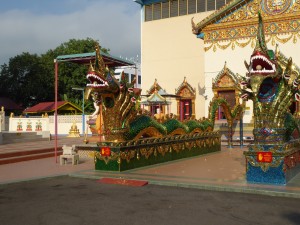
We’ve now spent two day in northern Malaysia, after our fun day in Kuala Lumpur, and we find this country to be even more diverse and interesting than we thought 2 days ago. The substantial Chinese influence in Penang was evident – red and gold everywhere, pagodas, dragons, lantern lights, Buddhas, etc. – like Chinatown on steroids. Yet, headscarves and burkas were also in view, as well as the facial markings and saris on the Hindu and Indian women.
One of our tourguides explained to us that the Malay, Chinese, Indian and Thai people in this area all enjoy a peaceful coexistence because the result is 14 public holidays every year, in addition to religious holidays for Buddhists, Hindi, Muslims, Taoists, Confucionists, Christians and others. We didn’t think she was kidding. Malay schoolchildren are taught Malay and English languages (and Tamil and Mandarin are also taught to children of Indian and Chinese descent, respectively).
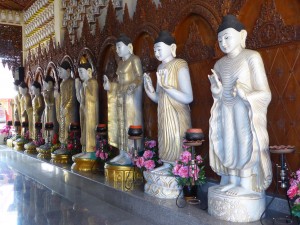
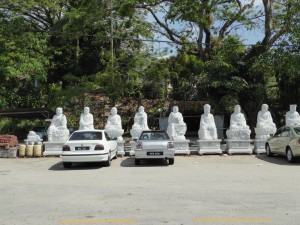
Yesterday we saw tons of temples – we took our shoes on and off about 8 times as we visited the Thai Buddhist temple and the Burmese Buddhist temple in Penang (across the street from each other), and then the enormous Kek Lok Si Temple, home to thousands of Buddha statues of all sizes and poses (including a line of large Buddhas in the parking area). This temple is an elaborate complex of various styles that unfolds up a hill with various gardens, shrines and sculptures having been added over time as donations come in for expansion.
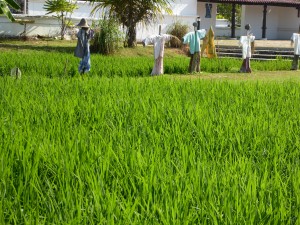
We also saw some lovely beach resorts (with prices that are very low compared to anything else we have ever seen), another batik/textile plant and some rubber plantations. And we learned more about growing rice – unlike Indonesia, which has more rain, Malaysians grow only 1 crop of rice each year, not 3.
The Peranakans (the Chinese who came to Malaysia years ago and prospered) lived an extravagant lifestyle in Penang, due in part to the profits from trading opium and other products. We visited a museum that was formerly the home of one of these titans, and saw a young couple posing for pre-wedding photographs, apparently a big tradition for the Chinese. The British colonial style architecture in Georgetown, Penang is beautiful, and reminded us of Bermuda in prior years.
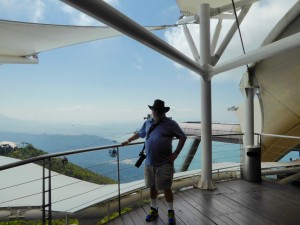
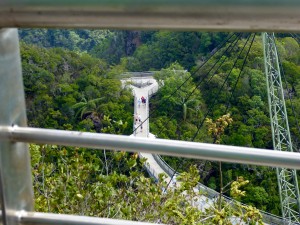
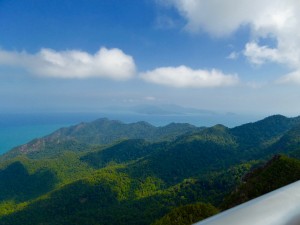
The literal highlight of our trip was a cable car ride to the top of Mount Gunung Mat Chinchang (2800 feet at 45 degrees, 15 minutes up and 15 minutes down). Once you get past the sheer terror of it, it is a peaceful ride, like floating through the air and listening to birds singing. On the ride and at the top, you can look out and see Thailand, the Strait of Malacca and the Andaman Sea.
So as we leave Malaysia (the ship has just started to move out of port), Joe and I wish you Buddha’s 4 blessings: love, peace, happiness and prosperity.
Best,
MA
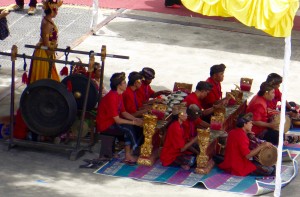
PS – Almost forgot to mention another benefit of being in this spot today – we saw the total solar eclipse this morning – very cool to see.


KL, Malaysia
Kuala Lumpur, Malaysia Monday, March 7, 2016
We have sailed through the Strait of Malacca and docked at Kuala Lumpur, Malaysia.
One quarter of the world’s sea cargo goes through the Strait – it is the shortest sea route (621 miles) between 3 of the world’s most populous countries (India, China and Indonesia). Half of the world’s oil travels through the Strait, and a lot of cargo (as in the Captain Phillips movie). Piracy has been reduced through aggressive international efforts.
Malaysia consists of parts of 2 islands, and became independent in 1956. Native Malay, Chinese and Indians co-exist in the country, which is governed by a democratically elected king (it’s complicated). Over 60% of the population is Muslim, so we have seen a lot of headscarves (over modern casual dress).
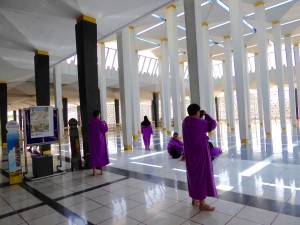
We spent yesterday visiting KL’s parks and town center, as well as the national mosque, which can house 15,000 followers (it’s the largest mosque in southeast Asia). We also saw the Aquaria, a huge underground complex with tunnels you can walk through as sharks, fish, rays, etc. swim by your sides and over your head, giving you a chance to see them up close and from every angle.
KL is a vibrant modern city of commerce and trade, which has prospered since it started as a tin mining site. It’s home to 1.7 million people who work in the leading industries of manufacturing (cars, palm oil, tea, rubber, tin, aluminum, etc.) and tourism. KL is a cultural hub and a technology and science center.
You might think that KL’s twin Petronas Towers are an accurate representation of the Malaysian capital’s modern prosperity, but the city has many parks and architectural reminders of its British colonial past. It’s a very interesting place, and one of the cleanest cities we have ever visited.
Tomorrow we visit more of northern Malaysia, and then we are excited to get to Singapore, where Joe spent many an evening with his work colleagues drinking Tiger beer and eating drunken prawns at the harbor restaurants.
Hope all is well with all of you.
Best,
MA


Recent Posts
- The American West July 1, 2026
- Yellowstone June 22, 2026
- A Few Side Trips in Portugal May 31, 2026
- Three Weeks in Lisbon May 29, 2026
- Sailing Along the Douro River May 23, 2026
Archives
| M | T | W | T | F | S | S |
|---|---|---|---|---|---|---|
| 1 | 2 | |||||
| 3 | 4 | 5 | 6 | 7 | 8 | 9 |
| 10 | 11 | 12 | 13 | 14 | 15 | 16 |
| 17 | 18 | 19 | 20 | 21 | 22 | 23 |
| 24 | 25 | 26 | 27 | 28 | 29 | 30 |
| 31 | ||||||