We visited diverse areas of Thailand over the course of several days. The visits included time spent in an outdoor museum that replicates part of Bangkok called the Ancient City; a training camp for monkeys where they learn to collect coconuts for processing, a giant Buddha and the island of Phuket. What follows are some photos from those visits; then some notes and photos from our visit to the island of Phuket.
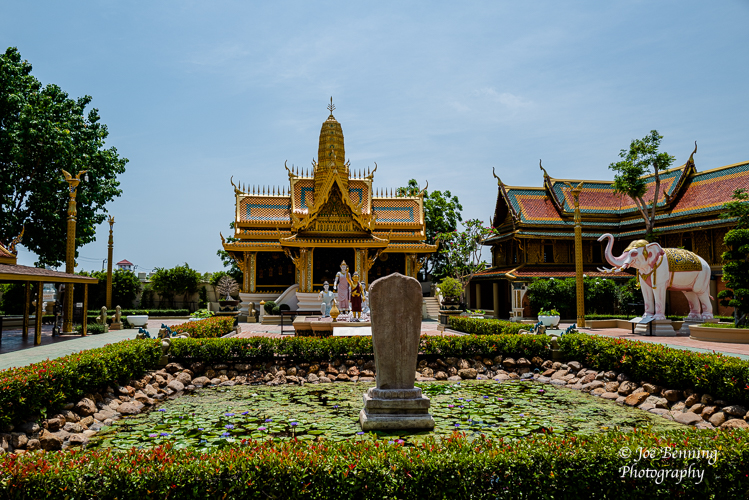
Bangkok, Thaliand — March 25, 2023. A wide angle photo of a temple compound in the Ancient City in Thailand.
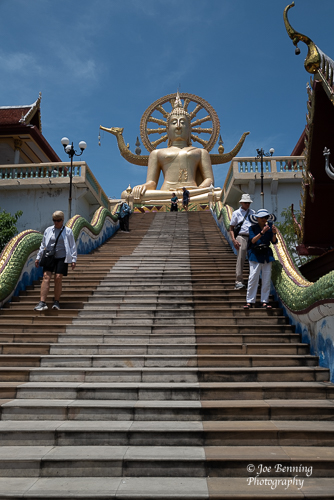
Photo of a giant Buddha at the top of a long outdoor stairway
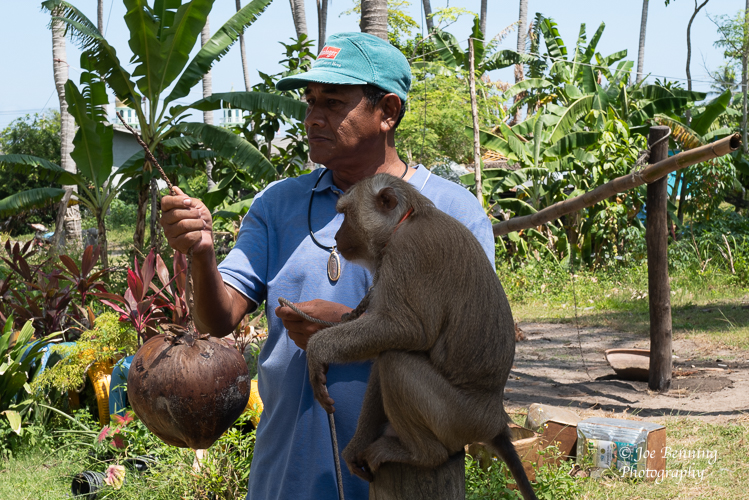
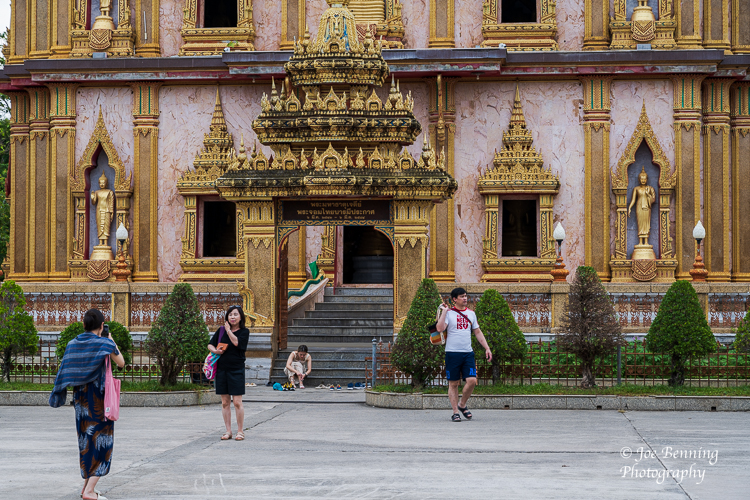
Phuket, Thailand–April 3, 2023. Photo of tourists on the grounds of Chalong Temple.Bangkok, Thaliand — March 27, 2023. Photo of a monkey trained to collect coconuts with his trainer at a monkey training camp.
The Island of Phuket
Located in the Andaman Sea, Phuket is a mountainous Thai island that is home pristine beaches and lots of high end restaurants and resort hotels. It was devastated by a tsunami the day after Christmas in 2004, but seems to have fully recovered since then.
A bit smaller than Singapore, Phuket is the second smallest island in Thailand. Over the centuries Phuket has been a trading destination for various powers including India and China. The Dutch, Portuguese, French and English also visited the island. But Thailand has never conquered or colonized.
We took a short tour around the island. Among other things we visited Chalong Temple, an Elephant Camp and a Cashew factory. Of course there are temples everywhere. Elephants are a symbol of Thailand. Monkeys are big in Thailand as well. And for some reason or other, Thailand is a major producer of cashews. So there you have it: a quick tourist view of Thailand.
JFB
Phuket, Thailand–April 3, 2023. Photo of tourists on the grounds of Chalong Temple.Phuket, Thailand–April 3, 2023. Photo of a worker minding an Elephant in a waterimng hole .Phuket, Thailand–April 3, 2023. Photo of a Thai woman at work in a cashew factory in Phuket.
During a visit to Penang, Malaysia we spent some time in the city of Georgetown, the capital. Georgetown is a city established about 150 years ago by British colonizers. It is home to many different ethnicities including Chinese, Indian, Arabian, Burmese and Malay people as well as expats from Eurasia, Thailand and elsewhere.
Beautiful gracious buildings built during British rule are located next to ornate temples and other colorful architectural masterpieces. Some of the temples reflect a mix of Buddhism and Confucianism. In addition to stops at several of these temples, we visited a water village located on one of several long jetties in the Straits of Malacca, located between mainland Malaysia and the island of Penang. We also visited a Clan house.
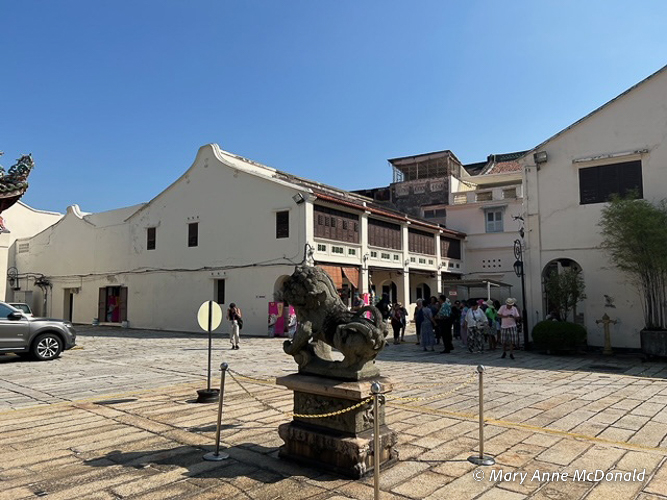
Courtyard at Khoo Clanhouse with Apartments in Background.jpg
The water villages were established because buildings on land were taxed, while buildings over the water were not. We visited Chew Jetty, named after the captain of the ship that brought Chinese immigrants to Penang. It was common practice for immigrants with no connection to their new home to adopt as a group the surname of their boat captain. One of the boats that carried immigrants to Penang was captained by Captain Chew, a surname that many of the Chinese immigrants adopted. Hence the name Chew Jetty to describe the area.
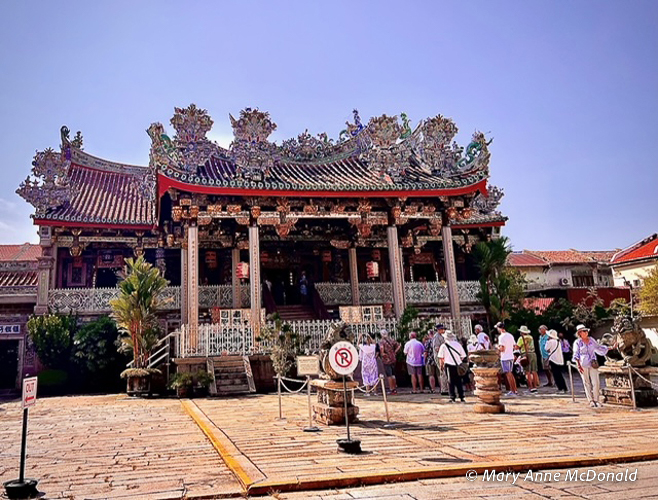
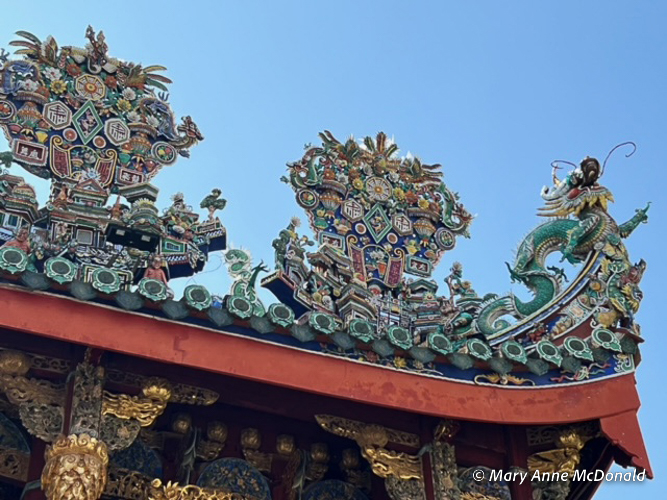
Temple at Khoo Clanhouse
As Penang developed, a group Clan houses, or (“kongsi”) were established in Penang by wealthy Chinese immigrants. The goal was to provide temples, housing and assistance to newcomers. The Khoo Clanhouse, which we visited, is one of the largest. You enter the compound through a large walkway, which brings you away from the busy street and into a compound with an ornate temple, a registration office for the newcomers, and apartments for them. Newcomers received help obtaining work, housing, food, etc. until they could stand on their own two feet.
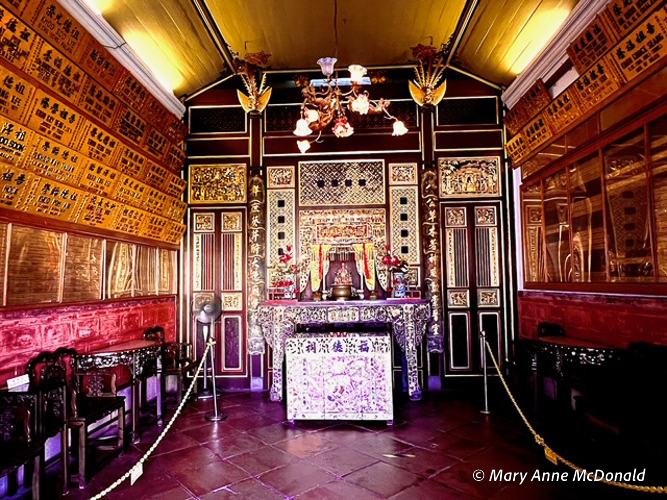
The Khoo Clanhouse was founded in 1835. Three areas make up the inside of the temple. There is a center area to worship of the god of prosperity. A small area to its right is for the worship of ancestors. It contains many replicas of gravestones from China where the ancestors were buried. Since the immigrants could not easily return to China, this area fulfilled a need for a local place to worship ancestors.
Small Room for Ancestor Worship.jpg
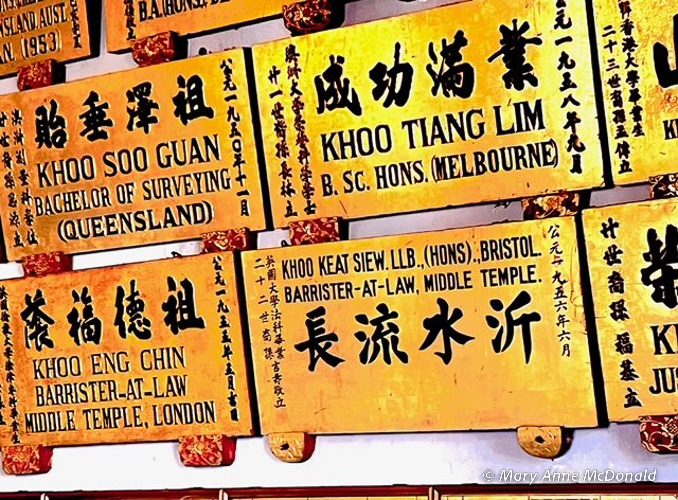
A small area to the left is a “hall of fame” with plaques to show the accomplishments of the Khoo family, and to inspire others. The plaques shown in the image below denote one surveyor, a recipient of the Bachelor of Science degree, and two barristers. There are hundreds of plaques in this area. Once a “hall of famer” dies, his plaque is moved to the ancestral worship temple.
Plaques in Khoo Temple.jpgDetail from Temple Roof, Khoo House